| In the 16th century neither terminology nor spelling were fixed.
So a pipe and tabor player could be, for example,
a
mynstrell, a musician, a drummer, a pyper, taber and piper, tabret, taberette or a fidler. It is impossible to know now
which of
some of these are taborers or players of other instruments as seen in contemporary images. |
| |
1506 poem ‘Passetyme of Pleasure’, by Stephen Hawes
“…There sat dame Musyke with all her mynstracy ;
As tabours, trumpettes, with pipes melodious,
Sakbuttes, organs, and the recorder swetely,
Harpes, lutes, and crouddes ryght delycyous ;
Cymphans, doussemers, wyth clavicimbales glorious.
Rebeckes, clavycordes, eche in theyr degree…” |
1532-1564 story
“ Be you there also, Trudon, said he to his drummer, with your pipe and tabour. The form
of matrimony
must be read,
and the bride kissed at the beat of the tabour…”Then the tabour
beat a point of war … Then
the tabour beat a retreat…
But what harm had poor I done? cried
Trudon, hiding his left eye with his kerchief,
and showing his tabour cracked on
one side: …
they have also broke my harmless drum. Drums indeed are
commonly beaten at weddings,—
and it is fit they
should; but drummers are well entertained, and never beaten…
Brother, said
the lame catchpole, never fret thyself; I will
make thee a present of a fine, large, old patent,
which
I have here in my bag, to patch up thy drum…”
‘The Horrible and Terrifying Deeds and Words of the Very Renowned Pantagruel King of the Dipsodes,
Son of the Great Giant Gargantua’ by François Rabelais, chapter 12
Great books of the Western World
by Encyclopaedia Britannica, pub 1986 |
1545 description of a Greek goddess:
“Cybele the daughter of the Minoan King ... and found by a shepherdess, she was brought-up
by her
and so became very beautiful and also wise , and [sounde sytlte] the pipe and tabour
and also the cymbals in Greece”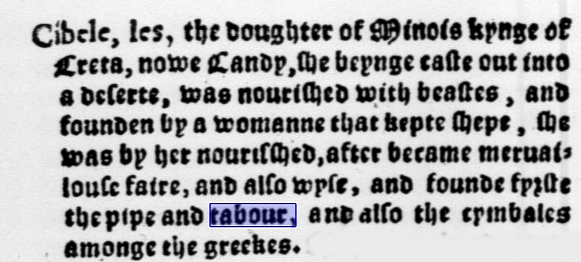 ‘Bibliotheca Eliotæ’, ... 1545 by Elyot, Sir Thomas. ‘Bibliotheca Eliotæ’, ... 1545 by Elyot, Sir Thomas. |
1560
“Woe be unto you and rise up early to give yourselves to drunkenness and set your minds
so on drinking
that you sit sweating thereat until it be night. The Harpe, the Lute, the Tabour,
the drumslade, the trumpet,
the shawm and plenty of wine are at your feasts, but the works
of the Lord do you not behold…”
‘The Governaunce of Vertue' in The Worckes of Thomas Becon’ |
1573
‘Kyng Alisaunder’ retells the story of Alexander the Great. The name of the author
is not known,
but he or she probably lived in or around London
“Noyse is gret with tabour and pype,
Damoysels playen with peren ripe.
Ribaudes festeth also with tripe;
The gestour wil oft his mouthe wype.”
The tabour and pipe make a loud noise.
Damsels play with ripe pears*;
good-for-nothings feast on tripe;
the storyteller will often wipe his mouth.
* pears were associated with lovers in medieval times
'The status and function of minstrels in England between 1350 and 1400' by
M A Price 1964 |
1575 song
“… they affirmed that to play in plague-time was to spread infection, and to play out
of plague-time was to breed it.
It was consequently ordained that the players—who,
“ if they were not her majesty’s servants, should by profession
be rogues”—must
perform only at weddings and private festivals, and only act in London during
the very healthiest season…
...Without a pipe and tabour
They only mean to labour
To teach each ox-hide neighbour.
This is the cause and reason,
At every time and season,
That plays are worse than treason….”
All the Year Round 1862-01-11: Vol 6 Iss 142 |
1583 story of Chykouan the Taborer:
“…The day of mariage was come, Chykouan goeth from his house
to fetche his Wife
at her Fathers,
and he himselfe brought her to the Church with his Tabor and pipe: ….
He goeth backe againe to his house,
and then he brought himself to the Church with
his tabor and pipe,
where he marryed his Wife, and then
brought her home, so that
he was himselfe both Bridegroome and mynstrell…”
‘The mirrour of mirth and pleasant conceits containing many proper and pleasaunt inventions, for the recreation
and delight of many,
and to the hurt and hinderance of none / framed in French by that worshipfull and learned
gentleman, Bonaduenture de Periers ...
and Englished by R.D.’ |
1585 “the fagge-end of an old man’s old will, who gave a good somme of mony
to a Red-fac’d Ale-drinker,
who plaid upon a Pipe and Tabor, which was this:
“To make your Pipe and Tabor keepe their sound,
And dye your Crimson tincture more profound,
There growes no better medicine on the ground
Than Aleano (if it may be found)
To buy which drug I give a hundred pound.”
'Drinke and Welcome' quoted in 'The Curiosities of Ale & Beer: An Entertaining History', by John Bickerdyke 1889 |
1587 or 1595 play: Thomas Tabrer is a minstrell in ‘John a Kent and John a Cumber,
A Comedy’ by Anthony Munday
Page 15 Enter Turnop, with his crewe of Clounes
and a Minstrell.
...Tom Tabrer. Heare ye, Hugh. Be not so forward : take a little use of your minstrell.
Omnes. And well sayd, Thomas Tabrer: you have scression ; speak on...
Enter John a Cumbek in his owne habit ; with him Turnop, Hugh, and Thomas the Tabrer. |
1590 from the jest book ' Tarlton's Jests and News out of Purgatorie'
The dead actor is made to declare: “they appointed that I should sit and play jigs
al day
on my tabor to the ghosts without cesing, which hath brought me into
such use, that
I now play far better than when
I was alive,” and he starts piping.”
[One in the long line of jest books which were popular in the 1590's.
Tarlton died in 1588
and this publication
traded on his name, there is no
evidence that he was the author of any
of these snippets.
Jest books were
collections of amusing stories, sometimes risqué many
of which were recycled
and owed much to stories
from the Italian Renaissance.]
‘The Elizabethan jig and related song drama’
by Baskervill, Charles Read |
1590 masque and antimasque:
from: The Masque of Flowers 1590
Silanus“His music, a tabor and a pipe, a bass violin a treble violin, a sackbut, a mandora”
Ulyssys and Circe – anti masque
“The music was composed of treble violins with all the inward parts; a bass viol, bass lute,
sagbut,
cornemuse, and a tabor and pipe. These, together dancing an antic measure”
‘A Book of masques: in honour of Allardyce Nicoll’, 1967 [Also see 17th century antimasques here] |
1590 pamphlet
“…he, not hearing the crie of the hounds, for the barking of dogs, (that is to say)
the minstrelsie for the fidling, the tune for the sound, nor the pipe for the noise of the tabor,
bluntly demanded
if they were not all beside themselves, that they so lip'd and skip'd whithout an occasion."
‘Plaine Perceuall the peace-maker of England Sweetly indevoring with his blunt persuasions to botch up a reconciliation
between Marton
and Martother. Compiled by lawfull art, that is to say, without witch craft, or sorcery: and referred
specially to the meridian and pole
artichoke of Nomans Land: but may serve generally without any great error, for more
countries then he speake of.' by
Richard Harvey |
1590 poem written in praise of Queen Elizabeth:
“…Sound out your trumpets then, from London's stately towers,
To beat the stormy winds aback and calm the raging showers;
Set too the cornet and the flute,
The orpharion and the lute,
And tune the tabor and the pipe, to the sweet violons,
And move the thunder in the air, with loudest clarions…”
‘Song to Beta’ by Michael Drayton |
1594 play
“…These called me forth to rouse thy master up
Tell him from me, false coward as he is
That Orlando, the County Palatine,
Is come this morning, with a band of French,
To play him hunt's-up with a point of war,
"to wake up Rodomont I'll be his minstrel with my drum and fife;
and invite him to meet me on the battlefield."
Bid him come forth, and dance it if he dare,…”
[Ed. Drum and fife probably mean instruments of war, not the pipe and tabor]
‘THE HISTORY of ORLANDO FURIOSO’ by Robert Greene |
 1595‘Popular Music of the Olden Time: A Collection of Ancient Songs, Ballads, and Dance Tunes, Illustrative of the National Music of England : 1595‘Popular Music of the Olden Time: A Collection of Ancient Songs, Ballads, and Dance Tunes, Illustrative of the National Music of England :
with a Short Introd. to the Different Reigns, and Notices of the Airs from Writers of the Sixteenth and Seventeenth Centuries :
Also a Short Account of the Minstrels · Volume 1’by William Chappell, George Alexander Macfarren · 1859 |
1598 play
“…Dull. I'll make one in a dance, or so; or I will play
On the tabor to the Worthies, and let them dance the hay….”
' Love's Labour's Lost - Act 5' by William Shakespeare; other Shakespeare quotes here |
1600 play ‘Shoemaker’s Holiday’
[ A noyse within of a Taber and a Pipe.]
Mayor. What noyse is this?
Eyre. O my Lord Mayor, a crue of good fellowes that for love to your honour are come hither with a morris - dance.
Come in, my Mesopotamians, cheerely!
[Enter Hodge, Hans, Raph, Firke, and other Shooemakers, in a morris;]
‘Shoemaker’s Holiday’ by Thomas Dekker. Dekker based his play on a prose tract titled The Gentle Craft by
Thomas Deloney, printed in 1598. |
1600
“…For even Minstrell Wenches of Samos, and such as profesied Dancing, […]
with her Tabour and Pipe,
and Agathtcleia , have over-toppcd Kings and Princes,
yea trodden their Crownes and Diadems under foot…”
‘The Works Of Plutarch of Chaeronea’ |