|
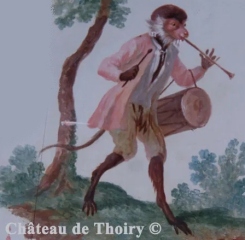
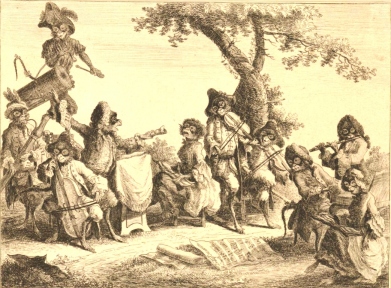 18th century monkey orchestra, France 18th century monkey orchestra, France |
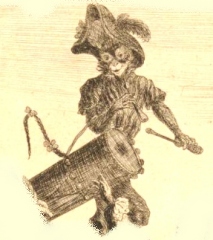 18th century, France 18th century, France |
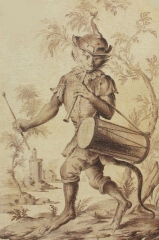 France France |
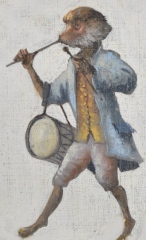 monkey monkey |
 modern harpsicord painting modern harpsicord painting |
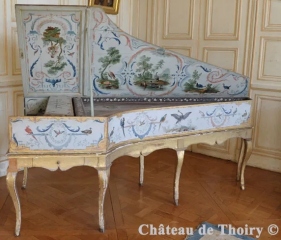 the harpsicord the harpsicord |
|
|
| |
players |
1772
“The Tabor-and-Pipe are two musical Instruments that always accompany each other ; and are mostly
used at Wakes by Country People, and at their Dancings and innocent Diversons -, and often with
Morris Dancers ; and sometimes in Concerts, if well perform'd by such as are skill'd in musick…”
‘The elements of musick display'd; or, Its grammar, or ground-work made easy: rudimental, practical, philosophical, historical
, and technical ..’
by Tans'ur, William |
BOUGHTON, John ('John a Stunsfield'), 1681 - 1753, played the taber and pipe in Gloucestershire, a taberer.
Record of payments for playing:
1699 December Aynho, gave J: of ?Stonesfield for play a day in Xmas on the taber + pipe 10-9
Northamptonshire Record Office, ML. 1306,
Cartwright Papers, Account book, October 1691 to 1722
1700 December Aynho, gave to J: of Stansfield ye taberer at Xmas 1-0-0
Cartwright Papers, Account book, October 1691 to 1722
1710 15 August Sherborne, To Jack of Stunsfield - 2 6
Gloucestershire Archives, D 678/148B, Dutton family accounts,
Account book beginning 1708, f.16
1710 16 August Sherborne, To Jack of Stunsfield - 10 –
Dutton family accounts, Account book beginning 1708
 'Percy Manning, Henry Balfour, Thomas Carter, and the collecting of traditional English musical instruments' by Alice Little 'Percy Manning, Henry Balfour, Thomas Carter, and the collecting of traditional English musical instruments' by Alice Little
Folk Music Journal, Vol. 11, No. 1 (2016), pp. 27-43
|
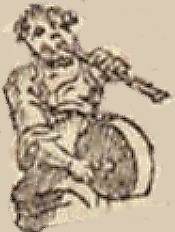 1702 Bible drawing 1702 Bible drawing |
 18th century pipe 18th century pipe |
|
| 1705 America and West Indies:
“… they have prevail'd with the Governour to make Thomas Burton Attorney Generall,
formerly a fidler to a known pyrate or privateer…”
Calendar of State Papers Colonial, America and West Indies: Volume 22, 1704-1705 |
1710. April 1,Tatler. No. 153
Addison touches lightly on faults that spoil the pleasures of social intercourse:
“I look upon myself, during the course of many years, to have resembled a tabor and pipe. I have since
very much endeavoured at the sweetness, of the lute but in spite of all my resolutions, I must confess with
great confusion, that I find myself daily degenerating into a bagpipe; whether it be the effect of my old age,
or of the company I keep, I know not.” |
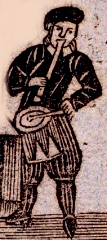 1720 woodcut 1720 woodcut |
1720
" The second time, Fryer Bungy and he went to sleepe, and Miles alone
to watch the brazen head; Miles, to keepe him from sleeping, got a
tabor and pipe, and being merry disposed, sung this song to a Northern tune "
Ancient Songs, Ballads, & Dance Tunes, Sheet Music & Lyrics |
|
1721 fidler thief trial account:
“ The Prosecutor depos'd, that the prisoner (being a Fidler) was sent for, to play at his House,
at which time he took an opportunity to convey away the Salt. That missing the Salt the next Day,
his Wife, upon enquiry, found it at a Goldsmiths, where the prisoner had sold it”
Proceedings of the Old Bailey, 6th December, t17211206-21 |
1720’s - 'Dixton Harvesters', a painting
in Cheltenham Art Gallery showing how the harvest was gathered.
The pipe and tabor player accompanied all the different activities, including morris dancing.
[ed.
The painting has poor lighting and is high up on the wall so difficult to photograph ] |
 part of the painting part of the painting |
|
1723 November 1. Thomas Herbert of Eglwysilan, gentleman left in his will
“To Thomas Morgan Lewis, ' ye fidler,' the little yellow mare.”
Wills: 1719-1778 Cardiff Records: Volume 3. |
1724, London
“Masters of various instruments flock here,
The Scottish pipe and British harp appear;
Lutes and guitars do form a beauteous line,
Whilst dulcimers with pipe and tabor join;”
‘The Session of Musicians,
In Imitation of the Session of the Poets.’ |
1726 playing in pantomime:
“Mr Harwood was paid I0s.6d. "pipſe}. & tabor;
for his attendance this nt." at Lincoln's Inn Fields
Theatre
on 17 October 1726 when the pantomime 'Jupiter and Europa' was played. A month later,
on 17 November,
he received 15s. 6d. for
"pipe; & tabor; & trav[el?]"...
|
1738
.”Miss Harwood performed in the chorus of Country
Lads and Lasses, with pipe; and tabor;
in
'The Burgomaster Trick'd', a pantomime acted
by a cast of children at Lincoln's Inn Fields Theatre
on 6 January 1738.” |
‘A biographical dictionary of actors, actresses, musicians, dancers, managers & other stage personnel in London, 1660-1800,’
by Philip H. Highfill, Jr., Kalman A. Burnim, and Edward A. Langhans. v.7 |
1752 - died: Mr. Harwood, the celebrated Performer on the Tabor and Pipe at Covent-Garden Theatre.
Kentish Weekly Post or Canterbury Journal Wed 06 May 1752 |
1731 fidler on trial:
Samuel Cole, and Edward Paine, of St. Sepulchres, were indicted
for assaulting William Brown on the Highway:
“Richard Pointer . I am a Musician, or a Fidler, or what you please to call me.”
Ordinary's Account. 8th December 1731. Westminster City Archives |
1737 dictionary definition: 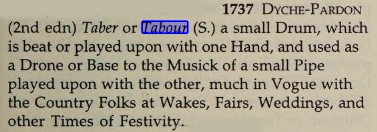 'An early music dictionary : musical terms from British sources, 1500-1740' by Strahle, Graham 'An early music dictionary : musical terms from British sources, 1500-1740' by Strahle, Graham |
1740 dictionary  'Musical dictionary : being a collection of terms and characters' by Grassineau, James 'Musical dictionary : being a collection of terms and characters' by Grassineau, James |
1749 London musician:  ‘The signboards of old London shops; a review of the shop signs employed ‘The signboards of old London shops; a review of the shop signs employed
by the London tradesmen during the XVIIth and XVIIIth centuries’ by Heal, Ambrose, Sir |
|
|
|
1755 part of advertisement: 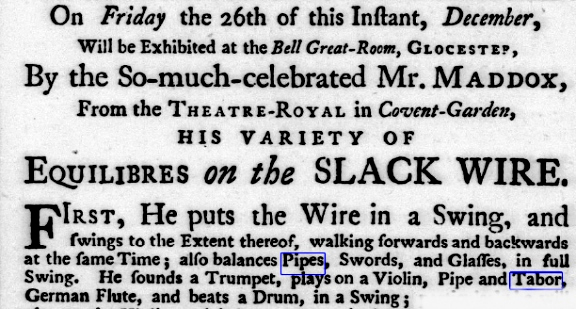 Gloucester Journal 23rd December 1755 Gloucester Journal 23rd December 1755 |
|
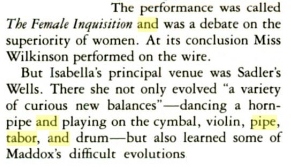
A Biographical Dictionary of Actors, Actresses, Musicians, Dancers, Managers ...
By Philip H. Highfill, Kalman A. Burnim, Edward A. Langhans |
1771 newspaper advertisement 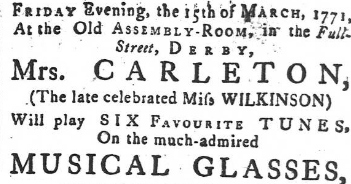 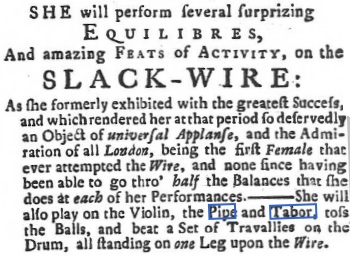 Derby Mercury - Friday 15 March 1771 Derby Mercury - Friday 15 March 1771 |
|
“the oldest of all London spas was the Islington Spa, or New Tunbridge Wells, now known as Sadler's Wells.
It was in 1684 that Mr. Sadler discovered in the grounds of his house a chalybeate spring….
The proprietor had the grounds fenced in and planted, engaged a lady to discourse sweet
sounds on a dulcimer in an artificial glen, and a man to play on a pipe and tabor in a shell-work
grotto for those who loved to dance...”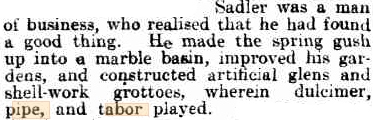 The Express and Telegraph, Adelaide, SA, Saturday 9 August 1902 - Page 4 The Express and Telegraph, Adelaide, SA, Saturday 9 August 1902 - Page 4
|
Friedrich Wilhelm Herschel, 1738 – 1822: a German-born British astronomer and composer.
Born in the Electorate of Hanover, William Herschel followed his father into the military band
of Hanover. [There is some difference of opinion as to whether he played the pipe and tabor
or the oboe in this band.] He emigrated to Great Britain in 1757 at the age of nineteen.
In addition to the oboe, he played the violin and harpsichord and later the organ. He composed
numerous musical works, including 24 symphonies and many concertos, as well as some church music. |
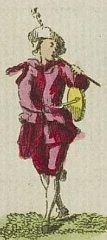 1760 drawing, London 1760 drawing, London |
|
1762 extract from newspaper advertisement: 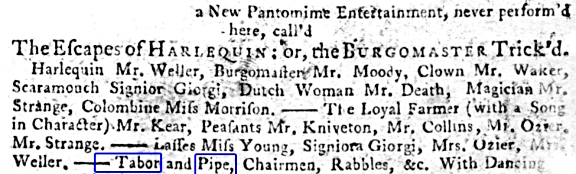 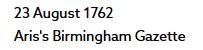 |
1766 story
"Being apprized on our approach,
the whole neighborhood came out to meet their minister,
drest in their finest cloaths, and preceded by a pipe and tabor:..."
'The Vicar of Wakefield' by Oliver Goldsmith |
1766
The pipe and tabor were used as a simile for the romantic rural idyll. 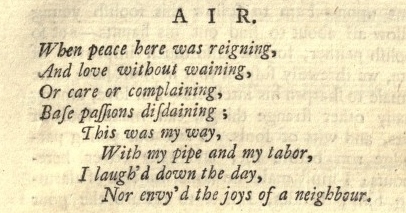 'Cymon A Dramatic Romance as it is Performed at the Theatre Royal, Drury Lane'. 'Cymon A Dramatic Romance as it is Performed at the Theatre Royal, Drury Lane'. |
1768 biography:
“Orange Sterling, in 1768, was a man of prime fashion and fortune; he played capitally on every musical instrument
… He taught me, for a whim of his and mine, the pipe and tabor;…”
‘Recollections of the life of John O'Keeffe : in two volumes’ ; 1 by O'Keeffe, John: 1826
|
1772 advertisement 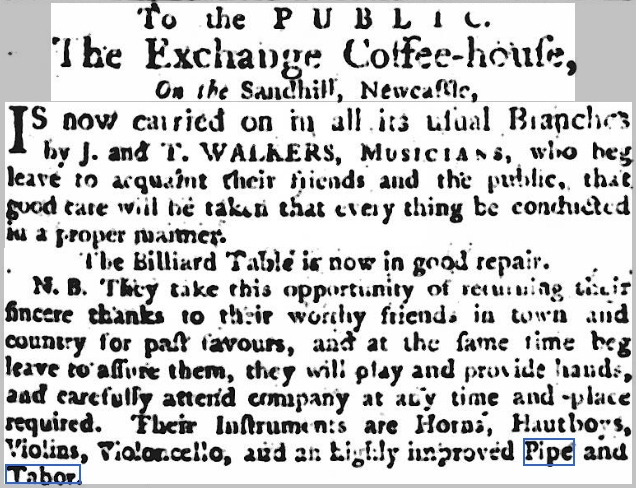 Newcastle Courant - Saturday 28 November 1772 Newcastle Courant - Saturday 28 November 1772 |
1788 A posthumous inventory made of Sir Samuel Hellier’s musical instruments
in his country house, The Wodehouse, Staffordshire, included "1 Pipe & Tabor”
Music in Country Houses of the English Midlands, 1750–1810 by Martin Perkins |
1770
"I have drunk with
Piping Pebworth, Dancing Marston,
Haunted Hillborough, Hungry Grafton..." |
25 years later Samuel Ireland wrote:
" the people of Pebworth are still famed for their skill
on the pipe and tabor; Hillborough is now called
Haunted Hillborough; and Grafton is notorious for
the poverty of its soil"
Samuel Ireland, Picturesque Views on the Upper or Warwickshire
Avon. 1795, p. 233 |
|
Theatre Royal Drury Lane between November 1767 and December 1768 the pipe and tabor
was hired 12 times for dancing and for plays. Between November 1774 and November 1775,
the pipe and tabor was used
for 127 nights during plays in the theatre.
In a
newspaper review
in September 1775 readers
were told:
“The music was well composed, and among other instruments were introduced the pipe and tabor” |
|
John Randall was born 1764 in New Haven, Conn. North America, died in Australia.
John Randall, a Negro laborer, was tried at Manchester on 14 April 1785 for stealing a watch chain
on the docks
at Liverpool. Sent to the Ceres hulk in 1786, aged 21; sentenced to 7 years transportation.
He was a crack shot. He was made an official game keeper by governor Phillip and killed the first Emu
seen by Europeans.
In June 1799 Randall was accused of theft of plates and glasses from the governor,
but was forgiven. Randall was about
6 feet and well built. He played the flute and tambour. |
1783 teacher' newspaper advertisement: 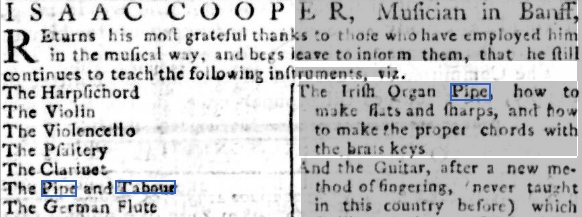 Aberdeen Press and Journal - Monday 31 March 1783 Aberdeen Press and Journal - Monday 31 March 1783 |
1787 Charles Dibdin Senior
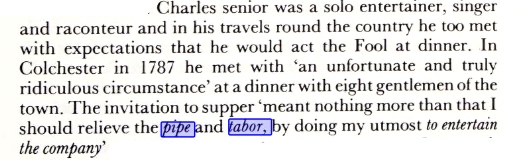 'A Social History of the Fool'
by Billington, Sandra 'A Social History of the Fool'
by Billington, Sandra |
1793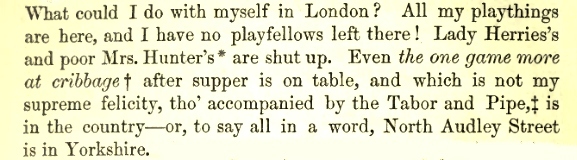 Extracts of the Journals and Correspondence of Miss Berry From the Year 1783 to 1852 Extracts of the Journals and Correspondence of Miss Berry From the Year 1783 to 1852 |
London business card 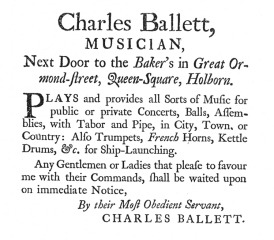 |
| |
|
|
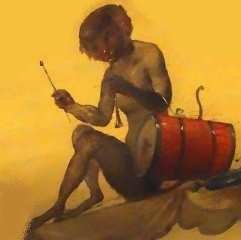
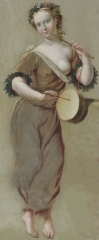 early 18thc Wentworth Castle, ceiling painting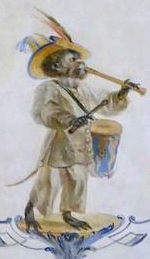
.jpg)