England: forgotten traditions
The Stang Ride
-o0o-
 plaster panel in the Great Hall, Montacute House, Somerset
 The original owner of the house, a 17th century magistrate, had this plasterwork panel illustrating the 'Stang Ride' placed in his Great Hall where he entertained important visitors. The many illustrations and mentions of the 'Ride' throughout historical times indicates a tradition well-known by the intended readership.

The husband is paraded around the village astride a pole as punishment. He was drinking whilst minding the baby, so his wife hit him over the head with a shoe and the neighbours take the law into their own hands by publicly humiliating him. He has behaved like a fool and is symbolically playing the pipe and tabor. 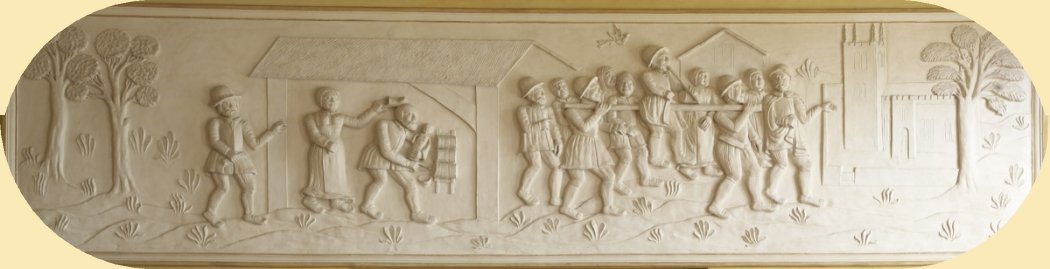 National Trust property contact & visitor info www.nationaltrust.org.uk ref 159695 ©NTPL/Nadia Mackenzie]
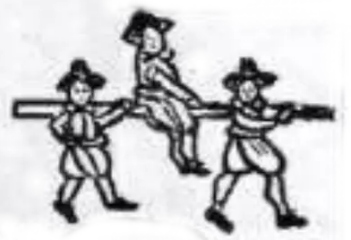
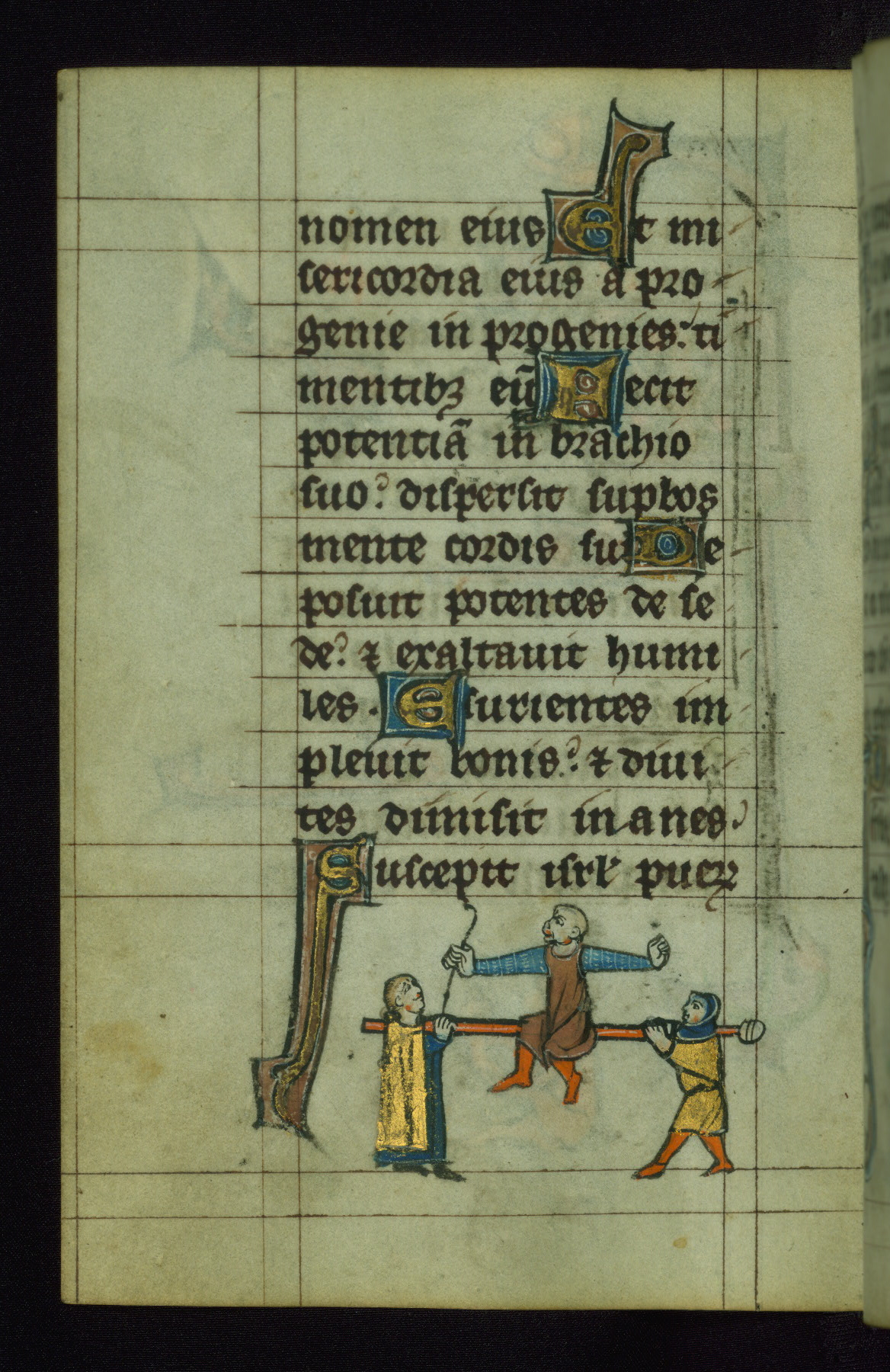
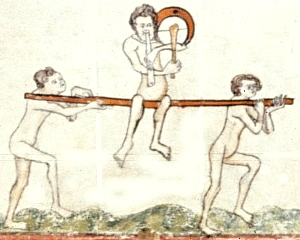 A French manuscript created between 1275 and 1325, illustrated in England in 1340, shows a pipe and tabor player A French manuscript created between 1275 and 1325, illustrated in England in 1340, shows a pipe and tabor playerbeing carried on a pole held between two men, although there is no clue as to why this happened. |
In the Luttrel Psalter (1325-35) in a similar scene the man is holding jester's/fool's bladder on a stick. 
In France, 1300-1310, a manuscript has a marginal image of a monkey sitting on a pole: 
A children's procession in a 14th century Flemish manuscript, (described as the 'winner of a cock fight'),
indicates that these rides were well-known enough to be mimicked as a children's game.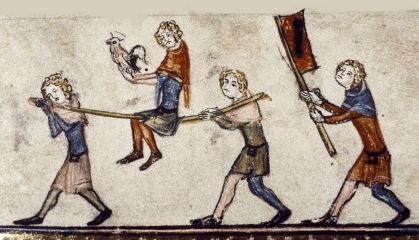
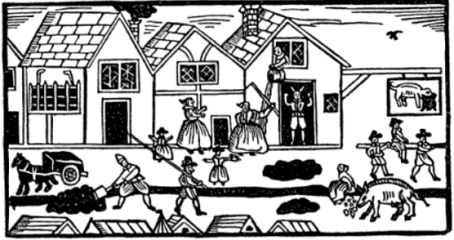
| The Stang Ride was a common custom for any man or woman who had committed a minor offence such as scolding, beating, or otherwise abusing the other sex. The man,(or "the neighbour next nearest the church" or even a paid volunteer), or man and woman together, were carried astride an ash pole, or stang, through their village or town. Insults, mocking laughter and derision, and missiles were thrown during the noisy procession. Rough music on horns, pots and pans, and drums added to the noise. |
||
March 1562 'PROTESTING INVERSIONS: Charivary as Folk Pageantry and Folk-Law' by Tom Pettitt |
||
"1562, Shrove Monday, at Charing Cross, was a man carried of four men, and before him a bagpipe playing, "Riding Skimmington" and "Riding the Stang". By C. R. B. BARRETT, Esq., 1895 |
||
1565 London, report on a stang ride: one man rode on two staves borne on four men’s shoulders at St. Katherines for that his next neighbour ‘Historical Memoranda of John Stowe: General, 1564-7’ |
||
1580 play 'Sivqila or Too Good to be True' by Thomas Lupton: "Riding Skimmington" and "Riding the Stang". By C. R. B. BARRETT, Esq., 1895 |
||
1601 22nd May, Carlton cum Willingham, Cambridgeshire, Court record: * cowlestaffe - a staff or pole used by two people to carry a vessel Diocesan Court Proceedings CUL: EDR B/2/1 |
||
1602 15th October, Waterbeach, Cambridgeshire, Court record:
Diocesan Court Proceedings CUL: EDR B/2/18 |
||
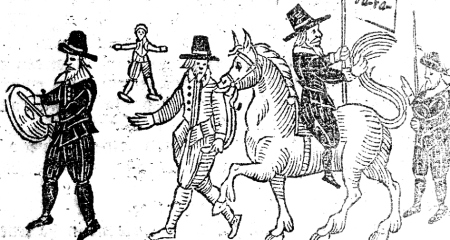 1602 Waterbeach, Cambridgeshire 1602 Waterbeach, Cambridgeshire |
||
1604 Wetherden, Suffolk: a riding against Nicholas Rosyer and his wife, after she beat him when he came home 'Popular Responses to Crime and Deviant Behaviour in Early Modern England' |
||
| In 1607 two churchwardens were taken to court in Somerset who apparently willingly 'rode the stang' during a particularly raucus Church Ale celebration: "Articles against Thomas Marsh and Roger Traske wardens at Yevel" recorded: "Some of the disorders at our Church ale at Yeavell this year 1607. It was an usual thing upon the saboth day to have minstrelsie and dauncinge and carrying men upon a cavell stafe, the wardinges themselves Thomas Marshes and Roger Traske wear willingly so caried to the church." |
||
1621 London;
Sir Francis Michell was the last English knight of the realm to be publicly degraded and undergo ‘Justice’. ‘The Skimmington Riots in the Forest of Dean, 1631-32: a contextual case study’ by Owen Adams, page 27 |
||
| 1631-32 Skimmington Riots in the Forest of Dean, Gloucestershire. Crowds estimated at between 500 and 3,000 people participated. "... divers of the inhabitants of Bicknor..., Sta[u]nton, Newland and Coluerd [Coleford]... to the number of five hundred at least... did with two Drummers two Coulers [Colours], and one fife in Warlike and outragious manner assemble themselves together..." |
||
|
||
1637
Appleton super Wiske, Yorkshire North Riding, trial record: “The duty of the master against Willelmum Steward a piper for playing upon his pipes before them” "All the parties before mentioned did fetch William Hodshone from his owne house & did carrye him Visitation Court Book of Archbishop Richard Neile, Borthwick Institute: V.1636/CB, part 2 |
||
The Stang Ride, or Skimmington Rides, were well-known in London. |
||
Andrew Marvell included a description in a poem in 1667 as the local people: |
||
At the Durham Assizes, 1793, seven men were tried for violently assaulting one Nicholas Lowes of Bishop Wearmouth, "Riding Skimmington" and "Riding the Stang". By C. R. B. BARRETT, Esq., 1895 |
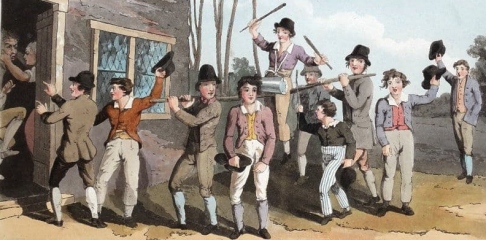 1814 The Stang Ride from "The Costume of Yorkshire" by George Walker
1662 “An Oration against a Foolish Custom: ‘ORATIONS OF DIVERS SORTS, Accommodated to DIVERS PLACES. Written by the thrice Noble, Illustrious and excellent |
|||
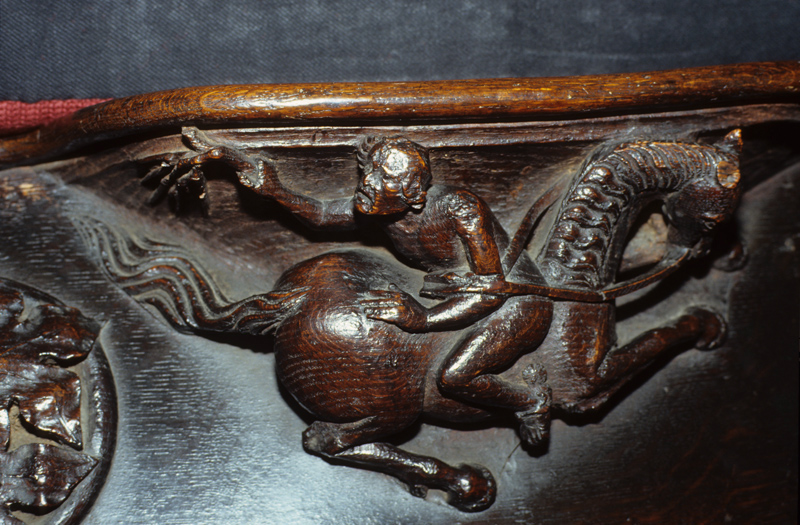
Sometimes the miscreant was carried backwards, which was a mark of shame, and which later became symbolic of evil. 'Riding Backwards: Theme of Humiliation and Symbol of Evil', Journal Viator, vol 4/1973 pp 153-176 |
|||
1382 London: the riding of a quack physician: recorded by Thomas Walsingham in ‘Historia anglicana’ ed. Henry Thomas Riley, 2 volumes, Roll Series 28 (London, 1864), |
|||
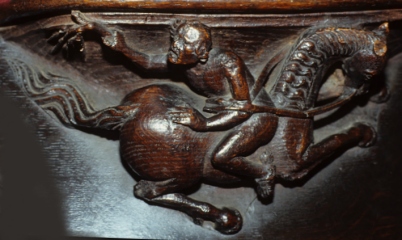 1330-40 misericord, Wells Cathedral, Somerset 1330-40 misericord, Wells Cathedral, Somerset |
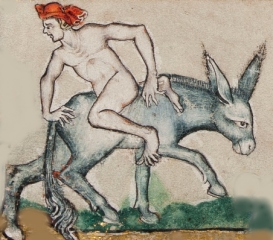 1330-40 manuscript, Norwich 1330-40 manuscript, Norwich |
||
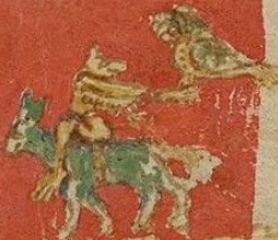 early 14th century ape riding backwards, England early 14th century ape riding backwards, England |
|||
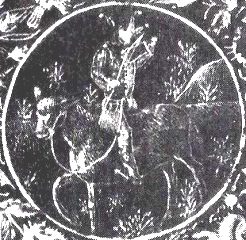 1470 musical fool, Bruges, Belgium 1470 musical fool, Bruges, Belgium |
|||
|
|||


A "mid-sixteenth-century chantry-priest, caught in flagrante with the wife of a London draper, 'PROTESTING INVERSIONS: Charivary as Folk Pageantry and Folk-Law' by Tom Pettitt |
|
| The Stang Ride theme was used as the basis for satires in, for example, 1607, 1726 . A 1772 satirical print shows the man riding backwards and carrying a distaff (symbol for female). |
|
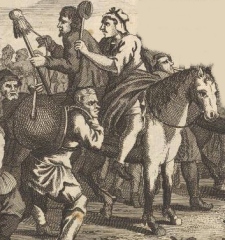 1725 Skimmington Ride, with a distaff, (women's work), England 1725 Skimmington Ride, with a distaff, (women's work), England |
"The flourishing of the distaff in the skimmington ride 'PROTESTING INVERSIONS: Charivary as Folk Pageantry |
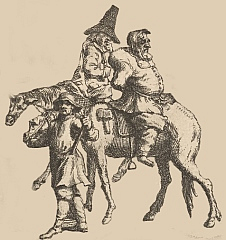 1721-1726 caricature (detail), England 1721-1726 caricature (detail), England |
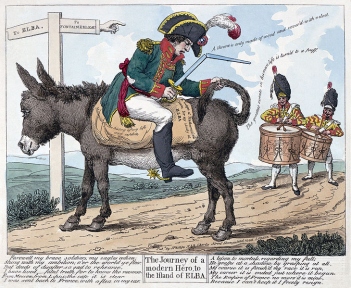 1814 satire on Napoleon, England 1814 satire on Napoleon, England |
The Stang Ride is also known as Riding Skimmington. It was well known throughout England and Scotland [2]
although may have originated or been particularly associated with only certain regions such as the West Country
or the north of England.
Both secular and ecclesiastical authorities suppressed the custom in England during the 18th
century and it died out in Victorian times.
Other mentions: ‘Robert Ill's 'Rough Music':Charivari and Diplomacy in a Medieval Scottish Court’ “curat of Mitton, and by violence putt him uppon a cowlestaffe and caried him up and downe the towne |
|
Mentions in Somerset: Quarter Sessions Records |
|
1703 satirical poem: 'Poems on affairs of state, from the reign of K. James the First, |
Two 18th century prints and a poem set to music here
* 1737 Skimmington Ride took place at Aveton Gifford, Devon, |
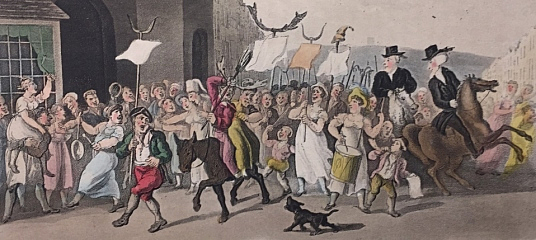 1812 satire 1812 satire |
|
1830's Doncaster, South Yorkshire The History and Archaeology of the Doncaster region |
|
1854 Description of a number of places where the Stang Ride was carried out such as Stockton, Norton, Thirsk: 'The History and Antiquities of the Parish of Darlington, in the Bishoprick'
by William Hylton Dyer Longstaffe, page 339 'The History and Antiquities of the Parish of Darlington, in the Bishoprick'
by William Hylton Dyer Longstaffe, page 339 |
|
Hunmanby Stang ‘HUNMANBY – A STORY OF TEN CENTURIES’ by Miss L.M.Owston, 1948 |
|
1877 Boldron, a village near Bowes, County Durham: the case of riding the stang went to court. The Darlington |
|
1884 Thomas Hardy, in his novel 'The Mayor of Casterbridge' indicates that
two women watch from a balcony "What do they mean by a 'skimmity-ride'?" he asked. "O, sir!" said the landlady, swinging her long earrings with deprecating modesty; "'tis a' old foolish thing they do in these parts |
| 19th century recollections of stang rides in: Clayworth, Retford, Nottinghamshire Preston under Scar, North Yorkshire Bubwith, Selby, North Yorkshire Lancaster Sturton by Stowe, West Lindsey district of Lincolnshire Tunstall, Lancashire? 'The James Madison Carpenter collection' |
1889 one of the last instances of Riding the Stang took place in Hedon, Holderness, East Riding of Yorkshire |
1898 Wensleydale: ‘Wit, Character, Folklore and Customs of the North Riding of Yorkshire With a Glossary of over 4,000 Words and Idioms Now in Use’ |
1901 Coverdale, near Leyburn. Yorkshire Dales, North Yorkshire, newspaper report: |
In Northamptonshire the Corby/Corbei Pole fair is organised every 20 years. The King (Henry III) granted the right
to hold two annual fairs and markets in 1226. Although the Pole Fair was only first documented in 1862 one theory
suggests that when the Danes settled in the area they brought their customs and punishments with them. The Old
English 'staeng' is said to come from the Old Norse 'stong', a pole,
"which this man was forced to sit atop or astride while carried upon the shoulders of a boisterous cavalcade of jeering neighbours, or represented in effigy and paraded through his village".
Definition of Stangster from "Forgotten English", by Jeffrey Kacirk, 1999
In 1902 tolls were exacted from passers-by and anyone not paying was carried through the fair on poles
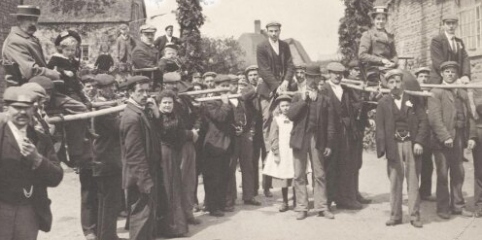 |
|
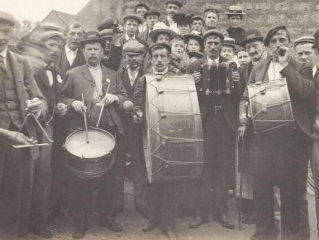 1902 Music was part of the festivities - Corby village band. 1902 Music was part of the festivities - Corby village band. Is the drummer on the right playing a three-hole pipe, a kazoo or smoking a cigarette? |
|
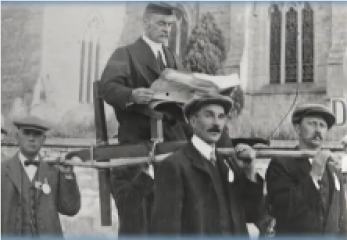 1922 Corby Pole Fair 1922 Corby Pole Fair |
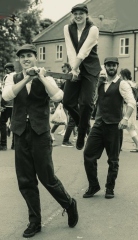 2022 Corby Pole Fair 2022 Corby Pole Fair |
In 1960 Anthony Gross produced an etching called Charivari: tumult
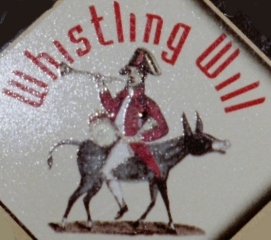 21st century beer sign
Similar customs occured in France:  1460's France, a fool, in the margin 1460's France, a fool, in the margin of 'Histoire Ancienne jusqu'á César' by Jean Fouquet |
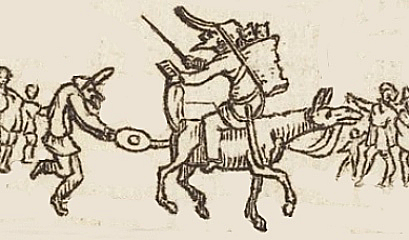 1622 in the background of commedia dell'arte engraving, Nancy, France 1622 in the background of commedia dell'arte engraving, Nancy, France |
||
| 1578 France, verse account, 'Collection of the ride, made in the city of Lyon' | |||
1718 France And as for Ash Wednesday, the deponent also saw another ox passing by belonging to François Simonin, plowman |
|||
1775 northeast France |
|||
1900 An old custom in Montluçon, central France:
|
|||
Similar customs took place in Germany: 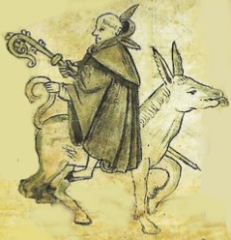 c.1540 The Abbot of Minden, Germany, riding backwards on an ass c.1540 The Abbot of Minden, Germany, riding backwards on an ass |
 1607 print, Ausburg, Germany 1607 print, Ausburg, Germany |
||
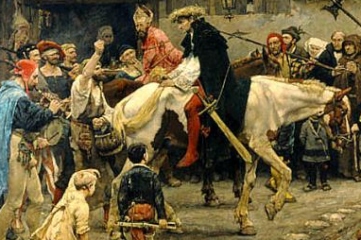 1879 Stockholm [detail] 1879 Stockholm [detail]'Peder Sunnanväder's and Mäster Knut's Ignominious Entry into Stockholm 1526' |
|||
 1884 illustration from ‘Adventures of Huckleberry Finn’ 1884 illustration from ‘Adventures of Huckleberry Finn’the King and the Duke tarred and feathered and ridden on a rail. |
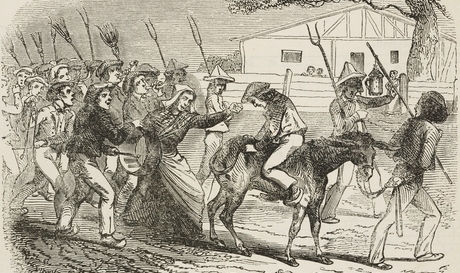
Similar customs survived into the 20th century in the USA and Australia, presumably taken there by colonists Riding the rail was a punishment most prevalent in the United States |
||
Another use for the stang: 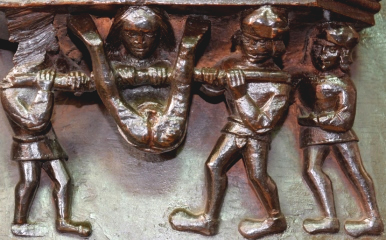 late 15th century acrobat on misericord, All Saints' church, Gresford, Wrexham, Wales late 15th century acrobat on misericord, All Saints' church, Gresford, Wrexham, Wales |
|||




Notes: other 'riding backwards' images here
[2] examples from Scotland
top of page