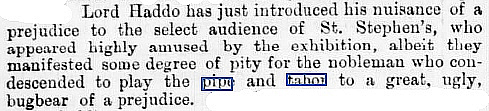
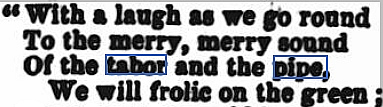
.......
The pipe and tabor were known throughout Victorian times. Many newspapers
had
literature or poetry columns. Sometimes advertisements were placed
in newspapers
advertising amusements to take place locally. Stories and plays
menioned the pipe and tabor in passing. |
| 1826 historical story
“What use of doctrine could be derived from a pipe and tabor?
Or was there ever aught like wisdom in a bagpipe?”
WOODSTOCK, OR THE CAVALIER. A TALE OF THE YEAR 1651 by SIR WALTER SCOTT, (1826) Chapter III. |
1827 opera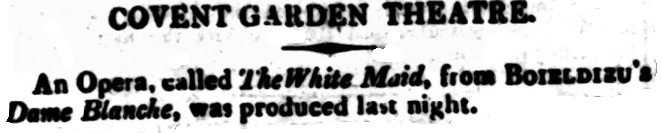 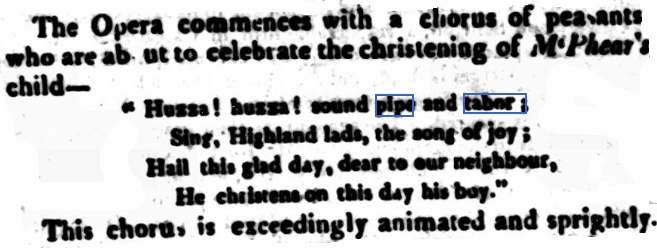 Star (London) - Wednesday 03 January 1827 Star (London) - Wednesday 03 January 1827 |
1830 poem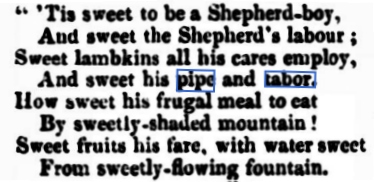 |
1830 poem
‘The Weapon-Shaw’ Sir Walter Scott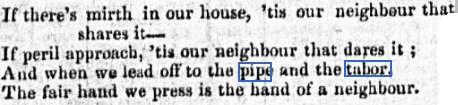 Stockport Advertiser and Guardian 27 August 1830 Stockport Advertiser and Guardian 27 August 1830
|
|
1831 play 'The Fire Raiser!'
[pipe and tabor heard in distance.]
" Arise, awake!—be glad, be gay'
For here are the merry sons of May !
Step, Squeak, pipe—beat, tabor—and bellow,…
Ruth. I thought I heard the sound of pipe and tabor ; —’tis melted into air like joy,
who seldom comes, and when he comes he stays not!...
[pipe and tabor heard, again].
But ’tis May-time, I must be merry—Ha ! the pole is ungarnished yet, I must away for blue-bell and primrose…”
‘The fire raiser! or, the Prophet of the moor! : a melo-drama, in three acts / by George Almar, Esq. author of Pedlar's acre... ; printed from
the acting copy, with remarks, biographical and critical, by D-G. ; to which are added, a description of the costume,-cast of the characters,
entrances and exits,-relative positions of the performers on the stage,-and the whole of the stage business, as performed at the Theatres Royal,
London ; embellished with a fine engraving from a drawing taken in the theatre.’by Almar, George |
1832 play
“…There, there, get you gone all to the lawn,
and be as merry as good cheer, strong beer,
and the pipe and tabour can make you….”
'The Agreeable Surprise' : a comic opera, in two acts by John O'Keeffe |
1832 poem 'Summer' 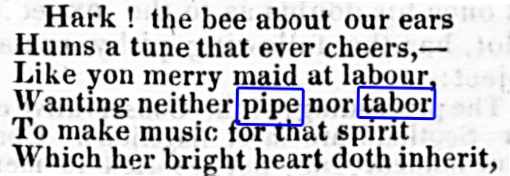 True Sun 26 December 1832 True Sun 26 December 1832 |
1832 poem 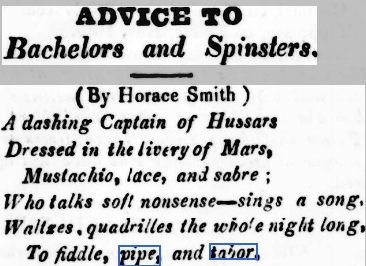 Clonmel Herald - Saturday 17 November 1832 Clonmel Herald - Saturday 17 November 1832 |
1833 newspaper article
“…Even there Genius was happy, and diffused happiness ;
at its bidding was heard pipe, tabor, and dulcimer ;
and to its lips “warbling melody” life floated by,
in the
midst of all oppression…”
Blackwood's Edinburgh Magazine 1833-10: Vol 34 |
1833 comic opera:
Chorus of Villagers.
“Come, Hymen calls, no longer stay;
The hour is come, we must be
While pipe and tabor gaily play,
To mirth and pleasure let us on !...”
‘Fra-Diavolo, or, The inn of Terracina : a comic opera in three acts’,
by Auber, D. F. E., Lacy, M. Rophino,;Scribe, Eugène, page 63 |
1833 poem 'I LOVE THE VILLAGE CHURCH'. 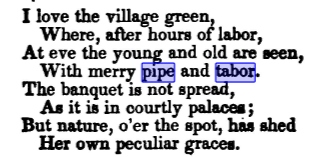 'The Souvenir Minstrel: A Choice Collection of the Most Admired Songs, 'The Souvenir Minstrel: A Choice Collection of the Most Admired Songs,
Duets, Glees, Choruses, &c ...
by Cornelius Soule Cartée |
1833 poem 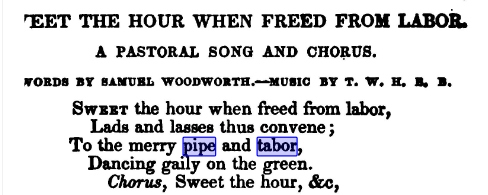 'The Souvenir Minstrel: A Choice Collection of the Most Admired Songs, 'The Souvenir Minstrel: A Choice Collection of the Most Admired Songs,
Duets, Glees, Choruses, &c ...
by Cornelius Soule Cartée |
1833 poem ‘The Farmer’s Family’ 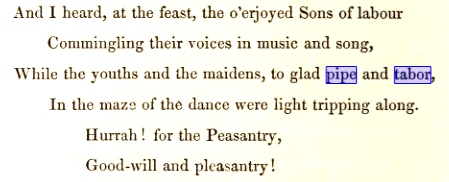 'The Emigrant's Tale : a poem, in two parts : and miscellaneous poems' 'The Emigrant's Tale : a poem, in two parts : and miscellaneous poems' |
1833 German / English dictionary - sang: 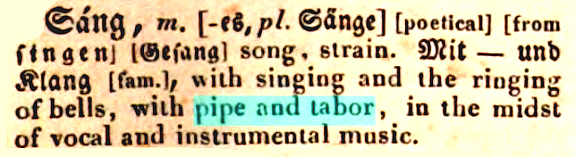 'A dictionary of the English and German languages. 2,2, Deutsch - Englisch; L – Z, by Hilpert, Josef Leonhard 'A dictionary of the English and German languages. 2,2, Deutsch - Englisch; L – Z, by Hilpert, Josef Leonhard |
1834 song ‘General Jackson’ to the air ‘Marlbrook’ ‘The Universal songster: or, Museum of mirth : forming the most complete, extensive, and valuable ‘The Universal songster: or, Museum of mirth : forming the most complete, extensive, and valuable
collection of ancient and modern songs in the English language, with a copious and classified index’
|
1834 poem
‘In this cottage he lived – In this cottage he died’ by E Knight
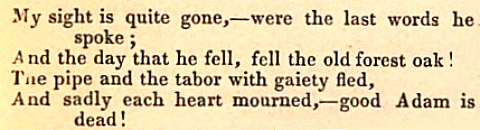 ‘The Universal songster: or, Museum of mirth : forming the most complete, extensive, and valuable ‘The Universal songster: or, Museum of mirth : forming the most complete, extensive, and valuable
collection of ancient and modern songs in the English language, with a copious and classified index’ |
1835 story
'The Overseer’s Daughter'
“…a field hard by was crowded with booths, tents, caravans, stalls, and other appendages of a fair. The sounds,
likewise, that fell upon her ear all denoted a scene of revelry and dissipation. Drums were beating, clarionets sounding,
bugles ringing, fifes screaming, and the pipe and tabour were heard only at intervals over the shouts of children, and
the loud murmur of hundreds of talkers….”
‘The Chronicles of Waltham’
by Gleig, G. R. (George Robert) -
CHAPTER II. SEEK AND FIND. |
1836 poem
‘Ode: to the Moon’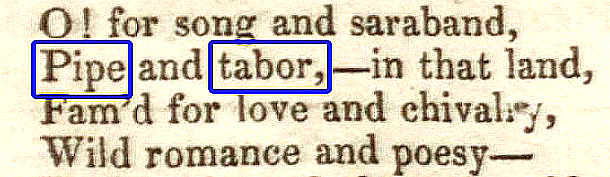 Kendal Mercury 30 April 1836 Kendal Mercury 30 April 1836 |
1836 poem 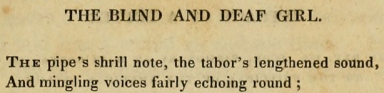 ‘The deaf and dumb or A collection of articles relating to the condition of deaf mutes : their education and the principal…’ Mann Edwin John ‘The deaf and dumb or A collection of articles relating to the condition of deaf mutes : their education and the principal…’ Mann Edwin John |
1837 poem 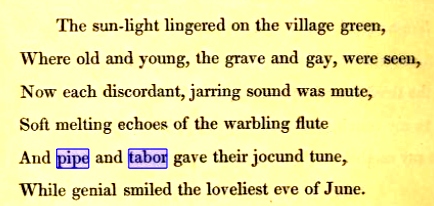 ‘Francis Abbott, the recluse of Niagara ; and Metropolitan sketches’ : second series ‘Francis Abbott, the recluse of Niagara ; and Metropolitan sketches’ : second series
by James Bird |
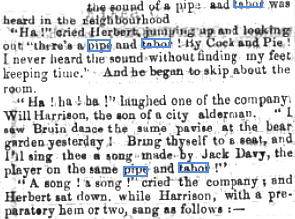
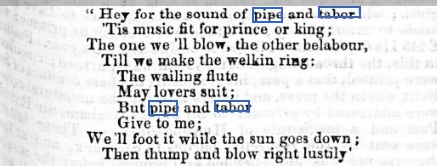
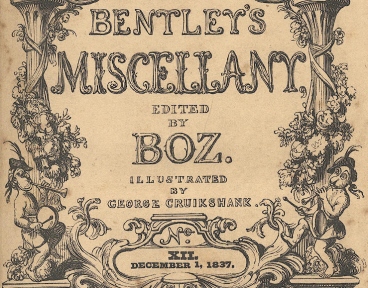
1837 poem  Bentley's miscellany. 1. 1837 Bentley's miscellany. 1. 1837 |
1838 madrigal: 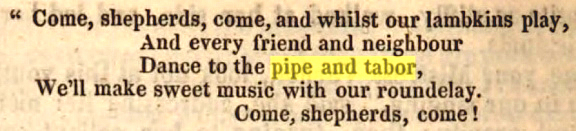 ‘Belletristical Works; 1, Shakspeare and his friends or The Golden Age of Merry England’ by Drake, Nathan ‘Belletristical Works; 1, Shakspeare and his friends or The Golden Age of Merry England’ by Drake, Nathan |
1840 story ‘The Recollections of a Hackney Coach’ 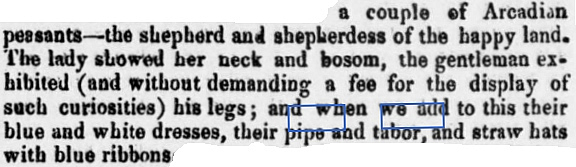 The Odd Fellow - Saturday 28 March 1840 The Odd Fellow - Saturday 28 March 1840 |
1840 story, description of a wedding procession:  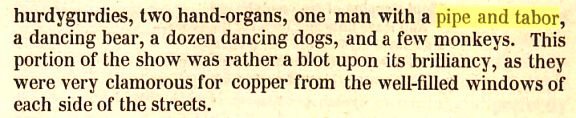 in ‘Jack Ashore, Works ; 1’ by Edward Howard, chapter XXI in ‘Jack Ashore, Works ; 1’ by Edward Howard, chapter XXI |
1840 poem title: 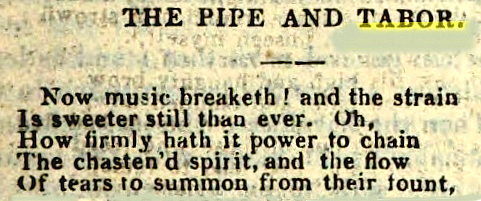 Ladies' Cabinet of Fashion, 1840-07 page 61 Ladies' Cabinet of Fashion, 1840-07 page 61 |
1840 story 'The Barred Bride' 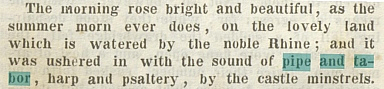 The Rhine : the most interesting legends, traditions, histories : from Cologne to Mainz : in two volumes / by Joseph Snowe, Esq. The Rhine : the most interesting legends, traditions, histories : from Cologne to Mainz : in two volumes / by Joseph Snowe, Esq. |
1840 story ‘Peveril of the Peak’ 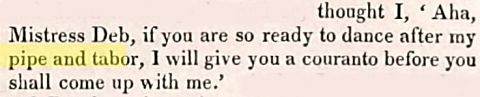 ‘The Novels of Sir Walter Scott’ 4, by Scott, Walter ‘The Novels of Sir Walter Scott’ 4, by Scott, Walter |
1840 essay‘On the Origin of the Romance Literature of the 12th and 13th Centuries chiefly with reference to its Mythology’
“…the pipe and tabor, and all manner of minstrelsye,'' are constantly heard under the green shade,
" when the wethur is cler and bryght,"
Two lectures read before the Essay Society of Exeter College, Oxford,
by Richard John King , Exeter College (University of Oxford ). essay soc |
1840 from the Vishnu Purana, a religious Hindu text, India,
translated by Horace Hayman Wilson, 1840.
This text is about the creation of the universe: CHAP. V.
“There are beautiful groves and streams and lakes where the lotus blows; and the skies are resonant with the Koïl's
song. Splendid ornaments, fragrant perfumes, rich unguents, the blended music of the lute and pipe and tabor; these
and many other enjoyments are the common portion of the Dánavas, Daityas, and snake-gods, who inhabit the regions” |
1840 play review:
“…he well knew what would please the frequenters of the theatre, and what himself. There is one character in it,
that is the one character, to which all the rest must play up. Macready knew that it would be his—that he would
be as the man playing the pipe and tabor to the dancing dogs around him….”
The Metropolitan 1840-07: Vol 28 Iss 111 ‘Glencoe ; or, the Future of the Macdonalds ; a Tragedy in Five Acts.’ by T. N. 'Tatrourp;
first represented the 23rd of May, 1840. |
1841 ‘The Pope’s Promise’ a story set in Macerata, Italy:  The Odd Fellow - Saturday 30 January 1841 The Odd Fellow - Saturday 30 January 1841 |
1841 poem 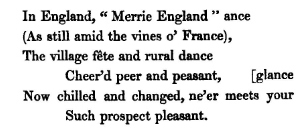 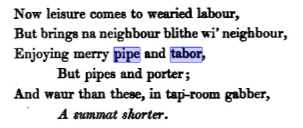 'Poems and Songs'
by
John Imlah 'Poems and Songs'
by
John Imlah |
1841 ‘Ode for April’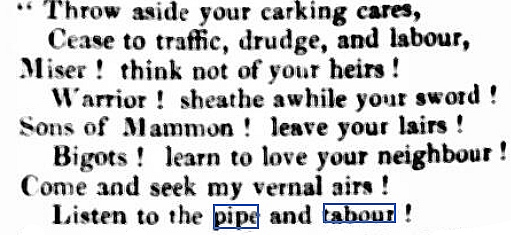 Worcester Journal - Thursday 08 April 1841 Worcester Journal - Thursday 08 April 1841 |
1841 song, ‘All Right to the tune of Packington Pound’ 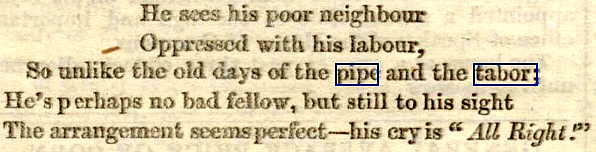 Bucks Herald - Saturday 21 August 1841 Bucks Herald - Saturday 21 August 1841 |
1841 poem ‘The Indispensibles’ Morning Advertiser 11 September 1841 Morning Advertiser 11 September 1841 |
1841 ‘The Comic Annual for 1842’ by T Hood  Taunton Courier, and Western Advertiser - Wednesday 24 November 1841 Taunton Courier, and Western Advertiser - Wednesday 24 November 1841 |
1841 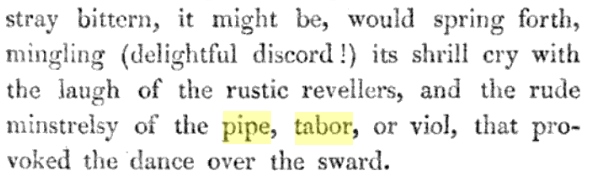 James Hatfield and the Beauty of Buttermere: A story of modern times. Volume 1 James Hatfield page 39 James Hatfield and the Beauty of Buttermere: A story of modern times. Volume 1 James Hatfield page 39 |
1841 story 'Esther: a tale of Spain in the sixth century'  ‘The Pic Nic papers’ by various hands edited by Charles Dickens Esq. ‘The Pic Nic papers’ by various hands edited by Charles Dickens Esq. |
unknown date: burlesque
“The next was a young shepherd, a buxom young lad,
And many's the frolic together we've had,
He used me so kindly, he shoved it in tight,
And he played a sweet tune on his Tabarin pipe.” |
1842 'The Pied Piper of Hamelin'
by Robert Browning in 'Dramatic Lyrics'
XIV The place of the children's last retreat,
They called it the Pied Piper's Street,
Where any one playing on pipe or tabor
Was sure for the future to lose his labor. |
1842  Critical and Miscellaneous Essays - Volume 2 Page 181 by John Wilson · 1842 Critical and Miscellaneous Essays - Volume 2 Page 181 by John Wilson · 1842 |
1842 Punch or The London charivari 3 Punch or The London charivari 3 |
1842
  Punch or The London charivari. 3. 1842 Punch or The London charivari. 3. 1842
|
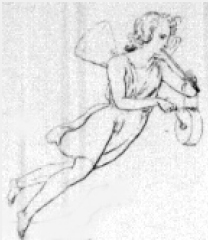 1833 'The Tempest' by Shakespeare, Ariel 1833 'The Tempest' by Shakespeare, Ariel |
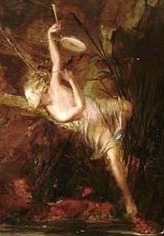 1840's The Tempest, Ariel 1840's The Tempest, Ariel |
1843 story ‘Adolphe and Annette or a Tale of Langudoc’  Lloyd's Companion to the Penny Sunday Times and Peoples' Police Gazette - Sunday 06 August 1843 Lloyd's Companion to the Penny Sunday Times and Peoples' Police Gazette - Sunday 06 August 1843 |
1843 poem 'The Starry Home'  Derbyshire Courier - Saturday 14 October 1843 Derbyshire Courier - Saturday 14 October 1843 |
|
|
1843 song ‘The Two Lieutenants’
Chorus
“…Then take thy pipe and tabor, boy,
And strike me up a merry tune—
For I was born in peascod time,
All in the merry month of June!...”
Anglo-American Magazine 1843-03: vol 1
1843 poem
‘INVOCATION’
“…While afar, but thither borne,
Swelling sound of sylvan horn,
Pipe, and tabour minstrelsy,
Tell of jollity and glee,…”
'Beads from a Rosary'
by Westwood, T. |
|
1843 newspaper column: 'May'
“Come May, blithe maiden, hand girl to that queenly damsel, Spring; … as in reluctance to o'erveil the happy group,
and stop the merry dance unwont to stay the pipe and tabor, bag-up the capering fiddle, or part the sighing swain
from doting maiden. Welcome, welcome, smiling May; blush, blush, blush; shine, shine…”
Illustrated London Life 07 May 1843 |
1843 play newspaper report
“HAYMARKET. On Tuesday evening, a piece in two acts, called ‘Who's your Friend? or The Queensbury Fete,’
was produced at this theatre, and obtained decided success….The appearance of Chloe (Lady Bab Blazon),
and Lubin (Viscount Leatherhead), two substantial specimens of pastoral swains, is the signal for the commencement
of the sports; and the pipe and tabor summon to the amusements all…”
Pictorial Times 26 August 1843 |
1843 Punch satire  Punch or The London charivari. 5. 1843 Punch or The London charivari. 5. 1843 |
1844 ‘Young Englandism’ a political essay  Liverpool Albion - Monday 17 June 1844 Liverpool Albion - Monday 17 June 1844 |
1844 letter to the Editor: Hereford Journal 10 January 1844 Hereford Journal 10 January 1844 |
1844 story ‘The Friar’s Study’
“…A sudden flourish from the pipe and tabor of Miles interrupted the Friar, who silenced the Minstrel
by an angry look:… flourish from the pipe and tabor of Miles momentarily distracted his attention;…”
‘Truths and Fictions of the Middle Ages: The Merchant and the Friar’
by Sir Francis Palgrave |
1844 poem ‘The Broken Violin’
“…How dismally slow will the Sabbath now run,
Without fiddle, or flute, or tabour —
How sad is the harvest when music there's none —
How sad is the vintage sans fiddle begun —
How can Heaven smile now on our labour !...”
‘The songs of Béranger, in English’
by Béranger, Pierre Jean de, ; Griswold, Rufus Wilmot |
1844 poem ‘Louis the Eleventh’
“…Village maidens, village boys,
Neighbour hand in hand with neighbour,
Dance we, singing to the tabour,
And the sackbut's merry noise !...”
‘The songs of Béranger, in English’
by Béranger, Pierre Jean de, ; Griswold, Rufus Wilmo |
|
1845 example of use  “Encyclopaedia Metropolitana; or, universal dictionary of knowledge, on an original plan: comprising the twofold advantage of a philosophical “Encyclopaedia Metropolitana; or, universal dictionary of knowledge, on an original plan: comprising the twofold advantage of a philosophical
and an alphabetical arrangement, with appropriate engravings” : Edited by Edw. Smedley, Hugh Jam. Rose, and H. John Rose. |
1845 newspaper report on a story:  Morning Chronicle 06 January 1845 Morning Chronicle 06 January 1845 |
1845 story
“…Then a dance was called for and the Brigadier's daughter and Handsome Hervey were commanded
to tread
a measure. To make things as characteristic as possible, Philip Dormer had provided himself
with a pipe and tabor,
and a pretty rustic dance was now danced to that very rustic accompaniment…
.Each shepherd danced a measure
with his shepherdess, and the pipe and tabor player was kept in pretty
active employment providing music for them….”
'Maids of Honour: A Tale of the Court of George I.'
by Robert Folkestone Williams |
1845 newspaper editorial:
“…If the ship of liberality were to enter our ports, … the pipe and the tabor, the song and the dance, would
inspirit even lassitude to new feats and grateful activities. But, the picture is a very different one!...”
Lloyd's Weekly Newspaper 30 November 1845 |
1846 poem
XXIX
“…For few may smile, as round the echoing drum,
With pipe, and tabor, piercing, shrill, and clear,
Falls on the heart, they vainly seek to cheer….”
‘Pleasures of homes : Domestic scenes and affections circle round the hearth’
by Farquharson, Stuart |
1846 poem  ‘The Prince Albert Vocalist’
by W.S. Johnson, ‘The Prince Albert Vocalist’
by W.S. Johnson, |
|
1846 poem ‘Solution of the Enigma‘ 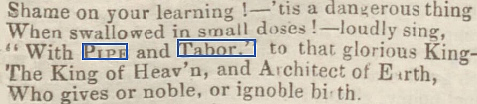 Western Times - Saturday 14 November 1846 Western Times - Saturday 14 November 1846 |
1846 newspaper political comment: ‘Claims of the Country Party’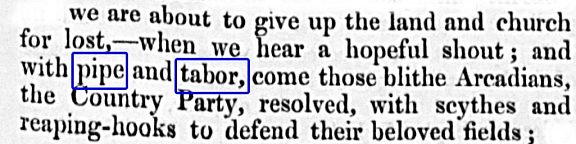 Douglas Jerrold's Weekly Newspaper 19 September 1846 Douglas Jerrold's Weekly Newspaper 19 September 1846 |
1846 newspaper political comment:
“FREE TRADE HOLIDAY.
We are fond of holidays; everybody is fond of a holiday; …Our worthy Mayor is aware of this.
He too is fond of a holiday; like ourselves he loves to see the masses in their moment of recreation-…
To a Sergeant with Mace, he would prefer a Sergeant with Tabor and Pipe, and would much
rather
be encircled by a wreath of flowers than a chain of gold…”
Leeds Intelligencer 01 August 1846 |
1847 poem 'Stanzas' by
Newton Goodrich 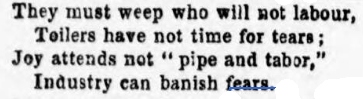 Lloyd's Weekly Newspaper - Sunday 15 August 1847 Lloyd's Weekly Newspaper - Sunday 15 August 1847 |
1848 review of ‘The White Lady of Avenel’
‘The opera commences with a chorus: "So gaily, so gaily the pipe and tabor sound," sung
by
the peasantry, who are about to celebrate the christening of Dickson's (Mr. O'Donnell) child,
an exceedingly animated and sprightly composition.’
Lloyd's Weekly Newspaper - Sunday 13 August 1848 |
1848 ‘An Uninvited Guest’; report of a Court Hearing:
‘passionate love for music and dancing. was going home through the Hotwell-Road when ” The sound of minstrelsy;
The pipe and tabor and the tinkling cymbal struck on his ear." He could not resist the temptation; the sounds
evidently issued from a window some fifteen feet above him ; but. in such cause, difficulties were as nothing,
and so, hoping that the window might be connected with a tavern, he began to clamber the wall, and attained
the required elevation. His appearance through the aperture was differently hailed—one cried. Come in. drink
and be merry,” while others shouted, Peck him over,” Down with the window and chop his head off,” and
fearing that one or other of the threats against him might put into execution, he made his way into the room....’
Bristol Mercury - Saturday 01 January 1848 |
1848 poem ‘A Voice of Encouragement A New Year’s Lay’ 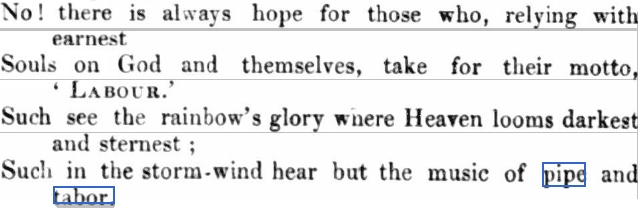 Dublin Weekly Nation - Saturday 01 January 1848 Dublin Weekly Nation - Saturday 01 January 1848 |
1848 operetta
GENERAL CHORUS.
“Laws we heed not, priests we need not,
While our hands are free ;
Fools may labour,—pipe and tabor,
With the bowl for me.”
The Andalusian; or, the young guard : an original operetta, in two acts / by George Soane, A. B |
1848 newspaper political comment
‘Postscript, London’

 Evening Mail 02 February 1848 Evening Mail 02 February 1848 |
1848 story:
“... Day was ushered in by a merry peal of bells from the tower of the old parish .... of bells was heard,
accompanied
by the merry sound of tabor and pipe. ..”
“…In the momentary silence that ensued the blithe jingling of bells was heard, accompanied by the merry
sound
of tabor and pipe "Ah ! here come the rush-cart and the morris-dancers,"
“…Sir Ralph then clapped his hands loudly, and at this signal the tabor and pipe struck up ; the Fool
and the Hobbyhorse, who, though idle all the time, had indulged in a little quiet fun with the rustics,
recommenced their gambols; the Morrisdancers their lively dance ; and the whole train moved towards
the May-pole, followed by the rush-cart…”
“…on the instant the lively sounds of tabor and pipe, mixed with the jingling of bells, arose from the court-yard,
and presently afterwards an attendant entered to announce that the May-day revellers were without…”
“…several lively dances were executed by a troop of male and female morris-dancers, accompanied
by a tabor and pipe…”
‘The Lancashire Witches - A Romance of Pendle Forest’ by W.H. Ainsworth |
1849 ‘The Trumpeter’s Wedding’ at the Theatre Royal, Haymarket, London
“The parties march to the church to the sound of pipe and tabor”
Globe - Thursday 22 March 1849 |
1849 ‘The True Workman’ verse 1 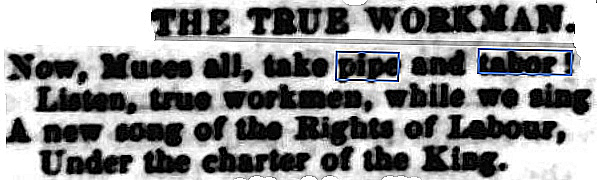 Nottingham and Newark Mercury - Friday 27 July 1849 Nottingham and Newark Mercury - Friday 27 July 1849 |
1850 story set in Elizabethan times: 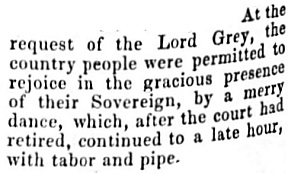 Lady's Newspaper and Pictorial Times 15 June 1850 Lady's Newspaper and Pictorial Times 15 June 1850 |
1850 poem 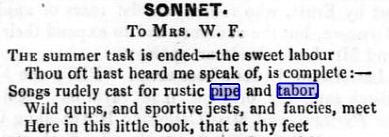 The Musical World 1850-06-01: Vol 25 Iss 22 The Musical World 1850-06-01: Vol 25 Iss 22 |
1850 story 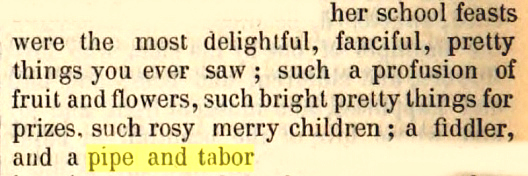 ‘The Wilmingtons’ by Anne Marsh-Caldwell ‘The Wilmingtons’ by Anne Marsh-Caldwell |
1850 story 'Cornelia' 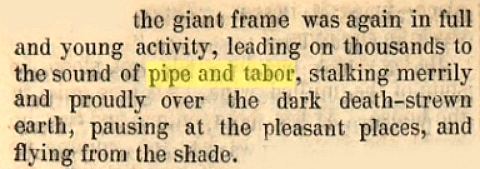 |
1850 essay‘The Polka’
‘..‘ Do you think, because you have corns, there shall
be no more pipe and tabor?” Poor Virtus indignans,
touched in so tender a point, limped off to its proper
sphere in the back drawing-room: where it finds rest
for its sore feet beneath the Card-table;…”
The Musical World 1850-06-29: Vol 25 Iss 26 |
|
1851 poem
Stanzas written on New Year’s Eve
“Wake then, ye minstrels, pipe and tabor,
And flutes and cymbals – softly-softly
Bid men arose to manly labour
And in its scabbard sheathe his sabre
And love his God, and love his neighbour.”
Durham Chronicle - Friday 03 January 1851 |
1851 A Christmas Garland 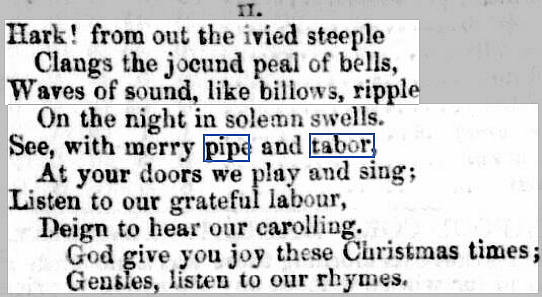 Bolton Chronicle - Saturday 20 December 1851 Bolton Chronicle - Saturday 20 December 1851 |
|
1851 story about a bear: 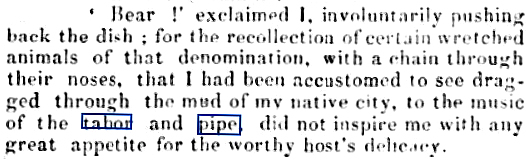 Manchester Courier and Lancashire General Advertiser Saturday 15 March 1851 Manchester Courier and Lancashire General Advertiser Saturday 15 March 1851 |
1851 essay:  Leamington Advertiser, and Beck's List of Visitors - Thursday 24 July 1851 Leamington Advertiser, and Beck's List of Visitors - Thursday 24 July 1851 |
1851 poem' Illustrated Proverbs' by John Wade Clinton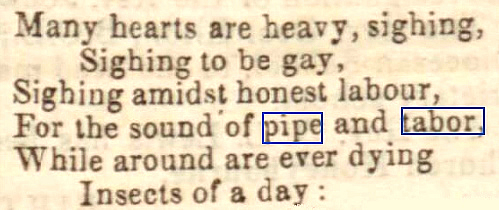 Worcestershire Chronicle - Wednesday 22 October 1851 Worcestershire Chronicle - Wednesday 22 October 1851 |
|
|
1852 poem ' The Love of Song' by John B Pedler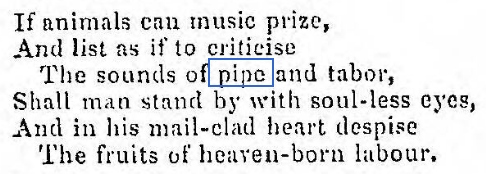 North Wales Chronicle - Friday 06 August 1852 North Wales Chronicle - Friday 06 August 1852 |
1852 poem: "Lines to an old tune, suggested by
the London
Art-Union print of " An English
Merrymaking in
the Olden Time."
“…England's lads and lasses meet.
To trip along on nimble feet ;
While fiddle, pipe, and tabor sound.
To aid them in the joyous round.”
Isabel C.
The Builder volume 10 issue 474 page 13 |
1852 'Amateur Theatricals - ‘A Wonderful Woman’ at Bath Theatre'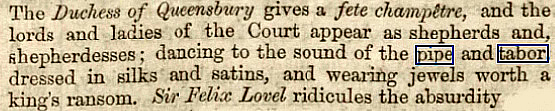 Bath Chronicle and Weekly Gazette - Thursday 15 January 1852 Bath Chronicle and Weekly Gazette - Thursday 15 January 1852 |
1852 commentary on ‘White Magic’
a two-act comic operetta
produced
at the Haymarket, London:
"the chorus Let pipe and tabor, with its
double subjects,
is ingenious and effective."
Illustrated London News - Saturday 20 March 1852 |
|
1852 operetta 'White Magic' 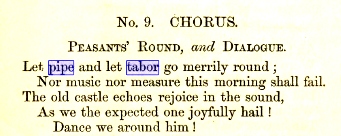 Words of the songs, duets, and trios, sung in White magic: an operetta, in two acts, Words of the songs, duets, and trios, sung in White magic: an operetta, in two acts,
as originally performed at the Theatre Royal, Haymarket, March 17, 1852
by Biletta, Emanuele |
1852 poem
“…He join*d the dance on summer eves,
Neighbour crossing hands with neighbour
To the merry pipe and tabor
The church where he his sabbaths kept,
The graves -where once his fathers slept,…”
'Democritus in London: With the Mad Pranks and Comical
Conceits
of Motley and Robin Good-fellow' ...
by George Daniel |
1852 poem
" Then, why should I give way to grief ?
Come, strike up pipe and tabor ;
He that affecteth God in chief.
And as himself his neighbour,
May still enjoy a happy life.
Although he lives by labor.''
This was the Song of Wither when at the age of seventy two,
broken in fortune, and a prisoner in Newgate !
'Democritus in London: With the Mad Pranks and Comical Conceits
of Motley and Robin Good-fellow' ...
by George Daniel |
1853 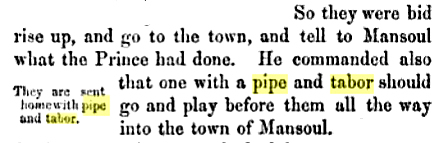 The Works of John Bunyan: Allegorical, figurative, and symbolical The Works of John Bunyan: Allegorical, figurative, and symbolical
b
y John Bunyan ·Page 304 |
1853 The Fancy Ball 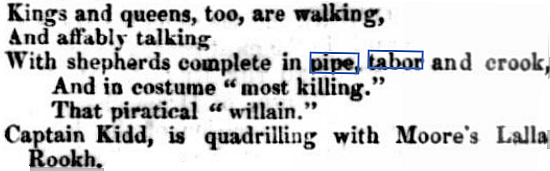 Coleraine Chronicle - Saturday 07 May 1853 Coleraine Chronicle - Saturday 07 May 1853 |
1854
essay
“…on saint-days, and Sundays, and festivals… be the occupants rich or poor, no work is attempted. Pic-nics,
tea-parties of all kinds, with singing and dancing, … the maiden and her lover, the priest, the peasant, the noble,
the trader, the busy townsman, all congregate; and, with the bright blue sky above, the rich green turf below,
the merry sound of pipe and tabor…”
‘Oranges and Lemons, in Household Words ; 25’ conducted by Charles Dickens |
1854 story - wedding procession
“…The merry notes of the pipe and tabour, the roll of the drums
, and the flourish of the wind-instruments, mixed with the pealing
of the bells, and the joyful acclamations of the peasantry announcing
the near approach of Lord Mowbray and his bride…”
‘ELLEN CLARE’.by Miss Agnes Strickland,.Chambers's Pocket Miscellany
by Chambers W. and R ., ltd |
|
1854 newspaper article:
"In truth there is no end to the vanity of some men.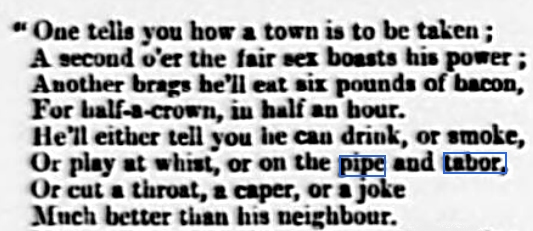 Leamington Spa Courier - Saturday 24 June 1854 Leamington Spa Courier - Saturday 24 June 1854 |
1854 poem 'Song for Holmfirth feast' 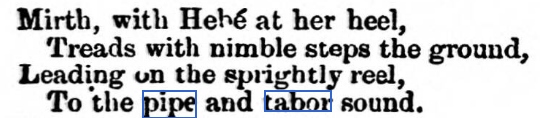 Huddersfield Chronicle - Saturday 27 May 1854 Huddersfield Chronicle - Saturday 27 May 1854 |
1854 Song 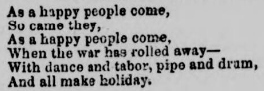 Manchester Times - Wednesday 28 June 1854 Manchester Times - Wednesday 28 June 1854 |
1854 essay
‘Oranges and Lemons’
“…with the bright blue sky above, the rich green turf
below, the Merry sound of pipe and tabor, the song
of birds of gorgeous plumage, the laugh of children
around and about, the fragrant perfume of orange,
and citron, and myrtle…”
Household Words. A Weekly Journal.
Conducted by Charles Dickens 1854-04-01: Vol 9 Iss 210 |
1855: The newspaper reviewer is bewildered by versification
as incoherent as the following: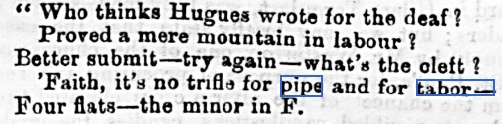 |
Review of the 1855 edition of 'Bentley's Miscellany':  Taunton Courier, and Western Advertiser - Wednesday 07 February 1855 Taunton Courier, and Western Advertiser - Wednesday 07 February 1855 |
1855 book review
YEAR-BOOKS. ‘Literally Literal Diversion’. (J. & C. Mozley.)
“…the compiler writes :‘‘ No light labour to the sound of pipe
and tabour the present compilation !—a labour truly still of love,
as cooing (wooing) is to dove, and eke of exultation (though not
of exaltation) as the author’s own creation! His time to fill up,
and to fill up old Time!” With this introduction we quit him,
unable to guess why a book so ridiculous should have been published….”
The Athenaeum 1855-12-15: Iss 1468 |
|
1856 The Witches Sabbath
“They dance to the sound of the tabor and flute, and
sometimes
with the long instrument they carry at the neck,
and thence
stretching to near the girdle, which they beat
with a little stick”
'THE WORSHIP OF THE GENERATIVE POWERS':
BY THOMAS WRIGHT |
1856 poem 'THE WORKINGMAN'
“…Wouldst thou be an idle drone,
Living on another's labor ?
Be a giant lazzarone^
Nodding to a pipe and tabor?...”
'Poems'
by B. Hallock |
|
1856 Christmas Song  Manchester Courier and Lancashire General Advertiser - Saturday 27 December 1856 Manchester Courier and Lancashire General Advertiser - Saturday 27 December 1856 |
1856 ‘The Death of the Old Year’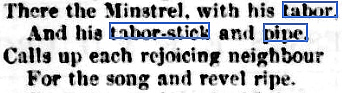 Maidstone Journal and Kentish Advertiser - Maidstone Journal and Kentish Advertiser -
Tuesday 30 December 1856 |
1856 ‘Celebrated Women No. 3 Fair Rosamund’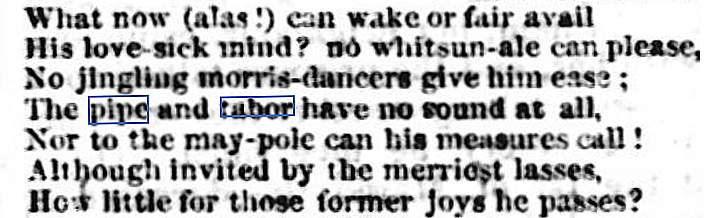 Commercial Journal - Saturday 19 July 1856 Commercial Journal - Saturday 19 July 1856 |
1856 poem 'Didactic?'
“…They must want who will not labour ;
Action hath no time for fear ;
Joy attends not " pipe and tabor”
Purpose high, alone, can cheer….”
"I TOO"
by Beelzebub |
|
1857 essay A JOURNEY IN SEARCH OF NOTHING. - NOTE THE FIRST. TRYING FOR QUIET. 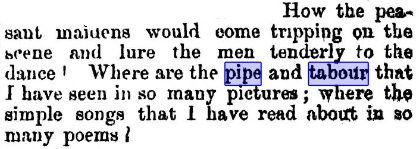 Household Words Vol. 16
by Dickens, Charles. Household Words Vol. 16
by Dickens, Charles. |
1857 story
"Who knows how he may have been disturbed? A pretty milliner may have attracted Harry’s attention
out of window—
a dancing bear with pipe and tabor may have passed along the common—a jockey
come under his windows to
show off a horse there?
There are some days when any of us may be
ungrammatical and spell ill. "
'The Virginians' William Makepeace Thackeray
“The air resounds with the pipe and tabor, and the drums and trumpets of the showmen shouting at the doors
of their caravans,
over which tremendous pictures of the wonders to be seen within hang temptingly; while
through all rises the shrill "root-too-too-too"
of Mr. Punch, and the unceasing pan-pipe of his satellite.”
1857 'Tom Brown’s School-days' Thomas Hughes |
1857 'A Song for Christmas': 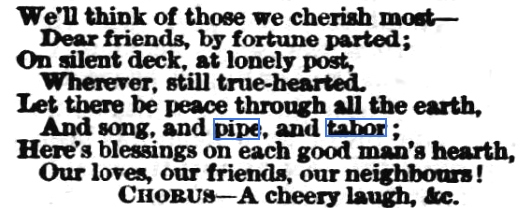 Birmingham Journal - Saturday 03 January 1857 Birmingham Journal - Saturday 03 January 1857 |
1857 ‘Anticipation of Spring’ 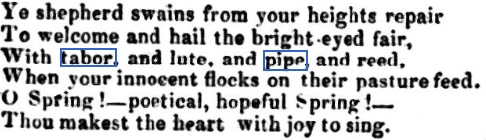 Longford Journal - Saturday 07 February 1857 Longford Journal - Saturday 07 February 1857 |
1858 poem ‘Roger Merryweather’ Durham County Advertiser - Friday 08 January 1858 Durham County Advertiser - Friday 08 January 1858 |
1858 Criticism of hymn: 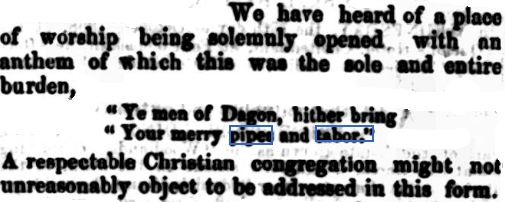 Cheltenham Examiner - Wednesday 29 September 1858 Cheltenham Examiner - Wednesday 29 September 1858 |
1858 poem 'Behind the Scenes’  Hampshire Advertiser - Saturday 18 December 1858 and ' Household Words. A Weekly Journal'. Conducted by Charles Dickens 1858-12-04: Vol 19 Iss 454 Hampshire Advertiser - Saturday 18 December 1858 and ' Household Words. A Weekly Journal'. Conducted by Charles Dickens 1858-12-04: Vol 19 Iss 454 |
1858 newspaper essay:‘History of Greek Literature’
“…A comfortably-lodged college don, especially if not crossed in love, will not wander with pipe and tabor from town to town…”
The Saturday Review : politics, literature, science and art. 06.11.1858, page 456
|
1859 Mythological Reception - newspaper story: 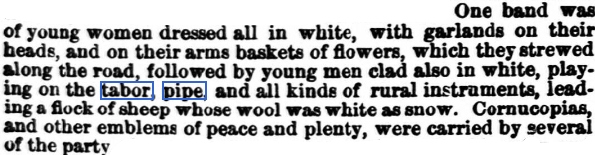 Nottinghamshire Guardian - Thursday 31 March 1859 Nottinghamshire Guardian - Thursday 31 March 1859 |
1859 poem
‘Castle-Building’
“…And festive rites beneath the moon
Were held, and like to concords sweet,
The pipe and tabor played in tune,
And round and round the jewelled feet
Of dancing girls the marbles beat ;…”
'Judith and other poems'
by Mills, Francis |
1859 report on a religious ceremony in Italy: 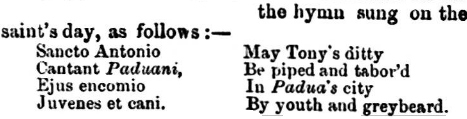 Globe - Tuesday 27 September 1859 Globe - Tuesday 27 September 1859 |
|
1860 opera, from the Flower Duet:
“No more of this—you see they come,
With cheerful pipe and tabor drum,
To hail my love their vintage queen.
And garland her with crown of green.”
'The night-dancers, a grand romantic opera, partly founded
on the story of Giselle
... as performed at the Royal English
Opera, Covent Garden'
by Soane, George |
1860 poem 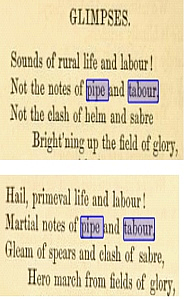 ‘Hesperus, and other poems and lyrics’ by Sangster, Charles ‘Hesperus, and other poems and lyrics’ by Sangster, Charles |
|
1860 poem Illustrated London News - Saturday 02 June 1860 Illustrated London News - Saturday 02 June 1860 |
1862
“in the retirement of his own apartment had spent his evening
as calmly among his books
as if the sound
of pipe and tabor had fallen on a deafened ear.”
Richmond Times Dispatch, November 1862 |
1862 hymn : 'Those eternal bowers'
"What! with pipe and tabor
Fool away the light,
When He bids you labour,—
When He tells you,—‘Fight!’ " |
1862 'Autumn' 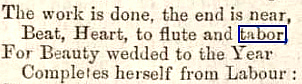 Coventry Standard - Saturday 25 October 1862 Coventry Standard - Saturday 25 October 1862 |
1862 poem 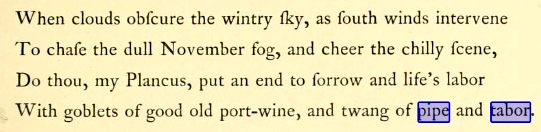 'Railway Horace'
by Oxenden, G. Chichester 'Railway Horace'
by Oxenden, G. Chichester |
|
1863 - 'Ode' by John Holland Sheffield Daily Telegraph - Tuesday 10 March 1863 Sheffield Daily Telegraph - Tuesday 10 March 1863 |
|
1864 story set in India  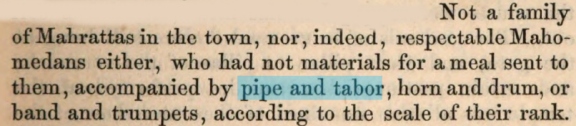 ‘Collections of British Authors, Vol 702 A Mahratta Tale‘ in three volumes, Tara. 1 by Taylor, Meadows ‘Collections of British Authors, Vol 702 A Mahratta Tale‘ in three volumes, Tara. 1 by Taylor, Meadows |
1864 At the Assembly Room in the Guildhall, Worcester,
in aid of the distressed weavers of Coventry: Prologue: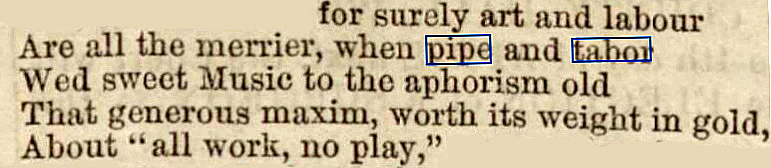 Worcestershire Chronicle - Wednesday 03 February 1864 Worcestershire Chronicle - Wednesday 03 February 1864 |
|
1864 sermon  Birmingham Daily Gazette
- Tuesday 01 November 1864 Birmingham Daily Gazette
- Tuesday 01 November 1864 |
1864 poem 'Ode toWinter' by John Greet 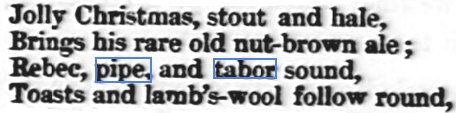 Leamington Spa Courier - Saturday 24 December 1864 Leamington Spa Courier - Saturday 24 December 1864 |
1865 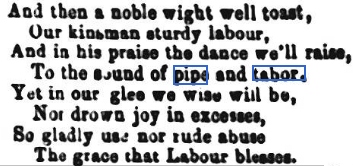 West Middlesex Herald - Saturday 09 September 1865 West Middlesex Herald - Saturday 09 September 1865
|
1865 'The Poets Pilgrimage' by Tom Hood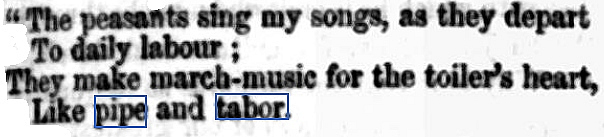 Soulby's Ulverston Advertiser and General Intelligencer - Soulby's Ulverston Advertiser and General Intelligencer -
Thursday 20 April 1865 |
1865
Amateur Concert in aid of the Cathedral Restoration Fund 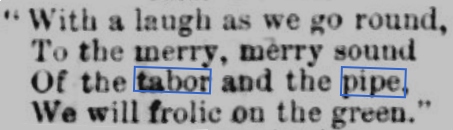 Chichester Express and West Sussex Journal - Tuesday 25 April 1865 Chichester Express and West Sussex Journal - Tuesday 25 April 1865 |
1865 ‘A Game of Romps with my Boys’ by Charles Kent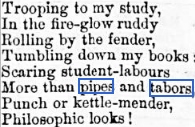 Sun (London) - Thursday 09 March 1865 Sun (London) - Thursday 09 March 1865 |
1865 ‘Confessions of a Wanderer’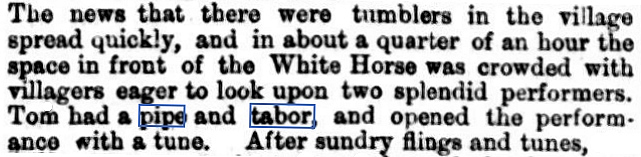 Blackburn Times - Saturday 29 April 1865 Blackburn Times - Saturday 29 April 1865 |
1865 The Witches Sabbath
“They dance to the sound of the tabor and flute,
and sometimes with the long instrument they carry
at the neck, and thence stretching to near the girdle,
which they beat with a little stick”
'THE WORSHIP OF THE GENERATIVE POWERS'
BY THOMAS WRIGHT |
1865 poem 'The Swallow’s Farewell'~
“…Children beneath me are sporting there,
Their voices rise clear it the evening air.
Pipe and tabor merrily sound,
Merrily swings the dance around ;…”
‘The Quadliteral: Poems’
by Campbell Mackinnon |
1865 Accompanied prose for Richard Dadd's
painting 'The Fairy Feller's Masterstroke'
“…Quite wonderful & see him walk
With lounging stride across the fields
Just turned afresh to raise the crop that yields.
Ample return for all his labour
That wants no sound of pipe & tabour….” |
1866 historical play
“…Sir Maurice Chudleigh, pedler, is my foster-brother, and will
ere long grace my wedding with his presence.
With him come
most
of his servingmen to foot it merrily to pipe and tabour…”
”…And you, lads and lasses, whose bells are tinkling and whose
feet
are ready for a merry measure, fall to,
and foot it your best
for the
honour of Devonshire. Strike up, Pipe and Tabour !
[A party of Morris-dancers then advances . After saluting the bride and bridegroom , an ancient
English Morris-dance is gone through….]”
‘True to the Core, a story of the Armada’
by Angiolo Robson Slous |
1867 story  ‘Cometh Up as a Flower’ by Broughton, Rhoda. Chapter XXX ‘Cometh Up as a Flower’ by Broughton, Rhoda. Chapter XXX |
1867 story
"…I am always right," replied Boardwine. "When have pipe and tabor been heard on Sundays until yesterday,
even in this, the most loyal village in England?...”
‘Leyton Hall, and other Tales : In 2 Volumes’ ; 1, by Lemon, Mark: |
1868 story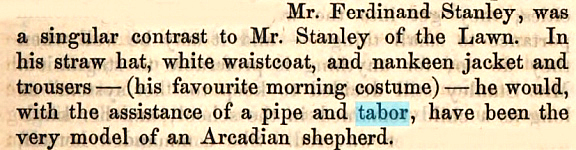 ‘Can wrong be right? : a tale’ by Hall, Anna Maria ‘Can wrong be right? : a tale’ by Hall, Anna Maria |
1868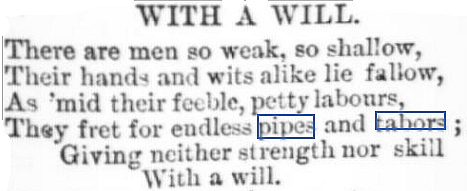 Oxford Times - Saturday 10 October 1868 Oxford Times - Saturday 10 October 1868 |
1868 A conversation between a botany lecturer and their pupil: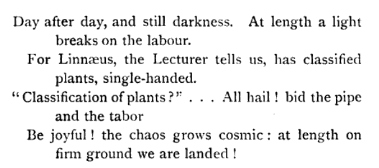 'Man of Science, A; or, The Botanist's Grave' 'Man of Science, A; or, The Botanist's Grave'
by Edward Robert Bulwer-Lytton (page 182) |
|
1868 Pipe and Tabor. "TENDER-HEARTED NELLIS's bosom is torn with the pangs of jealousy.
Thinking of one very dear to her. far, far away in Abyssinia …”
Fun, 1868-02, Vol.6, p.252 |
1869 poem 'April Fancies'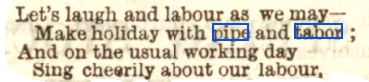 Exeter and Plymouth Gazette Daily Telegrams - Thursday 01 April 1869 Exeter and Plymouth Gazette Daily Telegrams - Thursday 01 April 1869 |
1869 story: ‘A Legend of the Wansbeck’ by W H Short 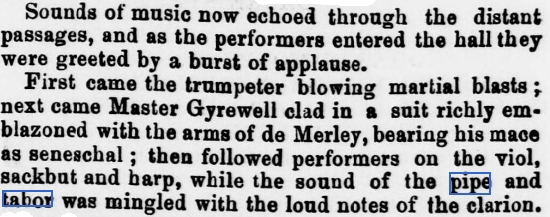 Morpeth Herald - Saturday 21 August 1869 Morpeth Herald - Saturday 21 August 1869 |
1869 story 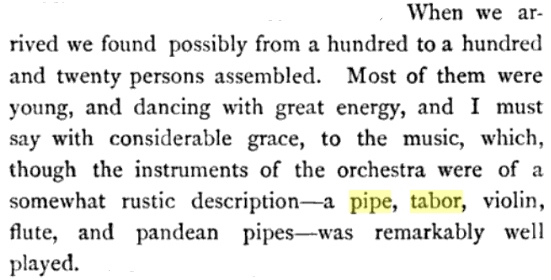 'King George's Middy' by William Gilbert page 293 'King George's Middy' by William Gilbert page 293 |
1869 poem
‘A Love Letter’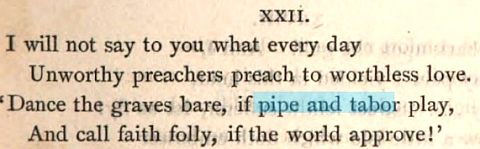 ‘The poems of Owen Meredith’, Robert Lytton ‘The poems of Owen Meredith’, Robert Lytton |
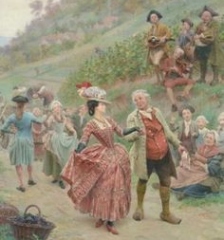 Victorian copy of 'Vicar of Wakefield'
date unknown Victorian copy of 'Vicar of Wakefield'
date unknown |
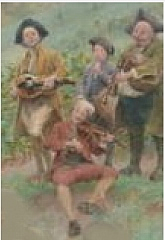 band on the hillside band on the hillside
[ed. here for
Regency original, 1817] |
'Sections 9ÔÇô10' - by John Edmund Reade
“...With his wallet stuffed, and eye
Twinkling through its corner sly.
There the Minstrel, with his tabor,
And his tabor-stick and pipe,
Calls up each rejoicing neighbour
For the song and revel ripe....”
date unknown |
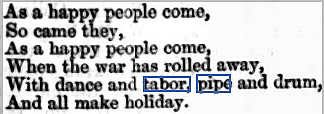
'A Chanted Calendar' by Sydney Thompson Dobell
“…Then came the daisies,
On the first of May,
Like a banner'd show's advance
While the crowd runs by the way,
With ten thousand flowers about them they came trooping through the fields,
As a happy people come,
So came they,
As a happy people come
When the war has roll'd away,
With dance and tabor, pipe and drum,
And all make holiday….”
date unknown |
'Master Hugues Of Saxe-Gotha'
by Robert Browning
XXVI.
“Who thinks Hugues wrote for the deaf,
Proved a mere mountain in labour?
Better submit; try again; what's the clef?
'Faith, 'tis no trifle for pipe and for tabor---
Four flats, the minor in F….”
source |
|
|