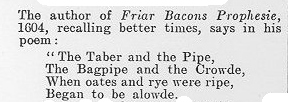
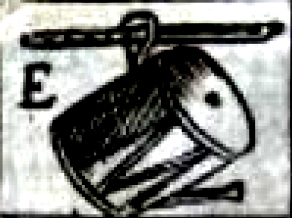
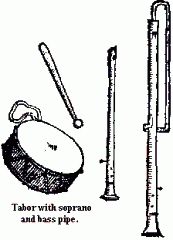
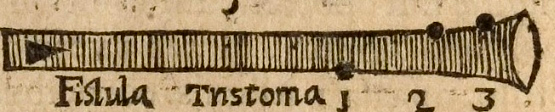
In the 17th century neither terminology nor spelling were fixed.
So a pipe and tabor player could be, for example,
a
minstrel, a musician, a drummer, a pyper, taber and pipe or a fidler. |
|
1637 Court antimasque
‘Britannia Triumphans’
"enter the severall Antimasques:
1. Entrie.
Of mockmusick of 5. persons.
One with a Violl, the rest with Taber
and Pipe, knackers and bells,
tongs
and key, gridiron and shoeing horn”
‘A Masque, Presented at White Hall, by the Kings Majestie and his Lords, on the Sunday
after Twelfth-night, 1637’
by Inigo Iones Surveyor of his Majesties workes,
and William Davenant
her Majesties servant.
page 10 |
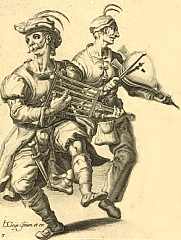 1596 Leiden, Netherlands 1596 Leiden, Netherlands |
|
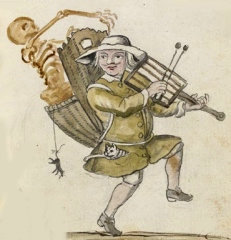
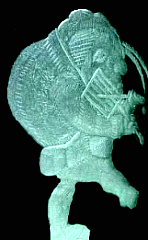
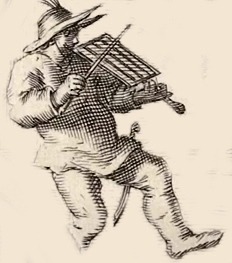
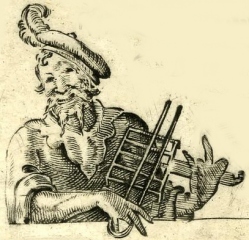
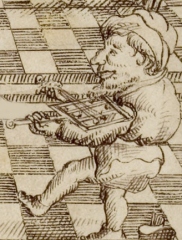
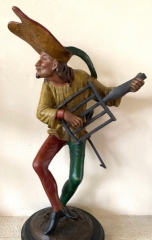
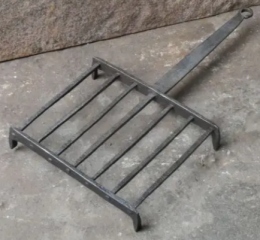
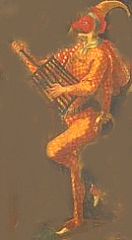
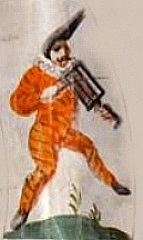
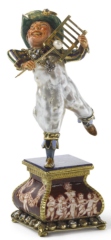
Playing this musical grill was a common practice among commedia dell’arte characters or other masquerade figures
during carnival celebrations in sixteenth- and seventeenth-century Europe.
The musical grill was not only a metal
idiophone to be struck with a stick
but it was held like a violin or a lute, imitating a musical instrument.
...Metal gridirons
were not the only kitchen appliances used by comedians
to make music: pots, spoons, knives,
and bellows accompanied
the music
of guitars, lutes or other actual musical instruments. |
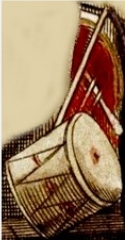
1613 a pipe and tabor played in another court masque, Silenus, along with other instruments.
“Before SILENUS marched four singers, and behind him five fiddlers; … The singers on SILENUS' part were a miller,
a wine cooper, a vintner's boy, a brewer. His music, a tabor and pipe, a base violin, a treble violin, a sackbut , a mandora…”
‘English Masques’ |
Masque, music for dancing: “the music was composed of treble violins with all the inward parts, a bass viol, bass lute,
sagbut, cornamute,
and a tabor and pipe.” |
1641 “… A gang of women, to the music of pipe and tabour, levelled the fences round a recent enclosure
and feasted
on cakes and ale to celebrate the act before they were caught and sent to jail by an angry magistrate….”
‘Rural Economy in Yorkshire in 1641, being the farming and account books of Henry Best’, ed. C. B. Robinson,
in 'The Great Rebellion. The King's War, 1641-1647
by Wedgwood, C. V. 2001 |
1661 translation and commentry of a classical text:
“…There were … ten Cybils, one of which was Phrygian Cybil, shee first invented the Tabor and Pipe, the Cymbal
and Timbrel: shee was called Mater Deorum, or the Mother of the Gods…Her priests… carried their Goddess Picture
about, beating their breasts, and miserably howling, after whom followed others playing on Tabors, Pipes, and Cymbals ... ”
Ovid, 43 B.C.-17 or 18 A.D.
‘The three books of Publius Ovidius Naso, De arte amandi translated, with historical, poetical, and topographical annotations’ by Francis Wolferston |
1687 ‘Remaines of Gentilisme and Judaisme’ Aubrey, John ‘Remaines of Gentilisme and Judaisme’ Aubrey, John |
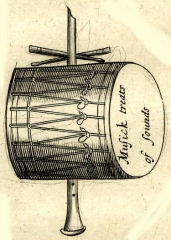
1694 “It hath been a common Practice to imitate a Tabour and Pipe upon an Organ. Sound together
two discording Keys … Though these of themselves should be exceeding smooth and well voyced
Pipes ; yet, when struck together, there will be such a Battle in the Ayr between their disproportioned
Motions, such a Clatter and Thumping, that it will be like the beating of a Drum, while a Jigg is played
to it with the other hand….”‘
A treatise of the natural grounds and Principles of harmony’ by Holder, William |
| |
cure for pain and illness |
1184 ‘Relief of Fevers’ by Mkhitar Heratsi, a book written by an Armenian physician addressed to physicians:
Therapy included the use of plant extracts, regulation of diet, physical exercise, hydrotherapy and psychotherapy.
He strongly recommended
to amuse, and in every way possible, make the patient happy especially listening to music
(delightful melodies).
‘Medieval Armenian Medicine A Short Historical Outline’ by Viktorya Vasilyan |
1622 melancholy cure
“ The Physitians will tell you, that the exercise of Musicke is a great lengthner of the life,
by stirring and reuiuing of the Spirits… it is most certaine, that those who are stung with
the Taramula, are cured onely by Musicke. Musicke is “the best Physicke for many
melancholy diseases…”
‘The compleat gentleman fashioning him absolute in the most necessary & commendable qualities concerning minde or bodie that
may be required in a noble gentleman.’ by Henry Peacham, Mr. of Arts sometime of Trinity Coll: in Cambridge. 1622 |
1673
"But different people with different instruments are affected by music, that is, by the different complexions, temperaments,
or Tarantulas, or men. I think it should be attributed to versatility; for those who are melancholic, or Tarantulas, are
poisoned with a more blunt venom. They were struck, preferring drums and noisy, clamorous instruments rather than
strings and fiddles”
'New Phonurgia' by A. Kircher, page 206 |
1678 the strange efficacy of it, and the most famous Musicians:
“I likewise knew another Person of Honour … who all her life-time did never used help of any
Physick,
how great soever her infirmities were; but in all her hurts, diseases, child-birth and laments,
she only desired
one who could skillfully play on the Tabour and Pipe, instead of a Physician.
Being well entered into Age,
an extreme pain seized upon her knee, … she called her Tabouret
instantly to play her a pleasant and lively
Coranto. The Tabouret striving to exceed himself in art
and dexterity, in readiness of wind and agility of hand,
fell down in a swoon, and so continued for
three quarters of an hour, the Lady then complain’d that her pain
and affliction was never so
extraordinary as in the time of the Musicks so sudden cessation ; The Musician
being recovered
and refreshed with a glass of brisk Wine, fell afresh to his former skillful musical playing,
and the Lady was thereby so eased of her pain, that it utterly left her.”
‘The wonders of the little world: or, a general history of man. In six books. Wherein is shewed what man hath been
from the first ages of the world in these times... In respect of his body, senses, passions, affections ... and many other
particulars’ by Wanley, Nathaniel, Vicar of Trinity Parish in the City of Coventry CHAP- X |
1682 cure for the bite of the tarantula:
“…Some doubt many have of the tarantula, or poisonous spider of Calabria, and that magical cure
of the bite thereof by music. But since we observe that many attest it from experience; since the learned
Kircherus hath positively averred it, and set down the songs and tunes solemnly used for it; since some
also affirm the tarantula itself will dance upon certain strokes, whereby they set their instruments against
its poison,… a Polish nobleman, bribed a man to undergo the same experiment, in whom the only result
was a swelling in the hand, attended by intolerable itching. The fellow’s sole remedy was a bottle of wine,
which charmed away all his pain, without the aid of “ pipe and tabor.”
‘Sir Thomas Browne. Works’.vol 1 reprinted 1894 |
1729 effects of music:
“MUSICK we find has so transendent a Power over us, as to raise or depress the Passions of the Mind, rouse or calm
the Motion of the Spirits …It is certain that Musick may very much contribute to the Cure of many Diseases;…”
'Medicine Musica: or a mechanical essay on the effects of singing, musick and dancing on human bodies' Browne, Richard |
1737 the medicinal powers of music:
" It is (says he) from the mechanical and involuntary connection between the organs of hearing and the consonance
excited in the outward air, joined to the rapid communication of the vibrations of this organ to the whole nervous
system, that we owe the cure of spasmodic disorders, and of fevers attended with delirium and convulsions."
"Music has the power of affecting not only the mind, but the nervous system, in such a manner as will give
a temporary relief in certain diseases, and at length even operate a radical cure.”
‘On the effects of music in curing and palliating diseases’ by Mathews, Samuel |
| 1745 Captain Graham returned from a voyage ill. The pipe and tabor music may have helped with the cure. |
|
 |
painting: Captain Lord George Graham in his Cabin |
|
1749 the use of music to treat fevers:
“the remedy, which of all others bids fairest to relieve the patient, is musick: as it awakes the attention in the most
agreeable manner, and relieves the anxious mind .… we have sufficiently proved, that musick bids fair to divert
the course of the spirits, and to maintain them in their just poise and movement.”
‘Reflections on ancient and modern musick with the application to the cure of diseases’ Brocklesby, Richard |
1774 die or live and dance, poem:
“…So now this Axiom I advance,
Remove Disease by Song and Dance -
…To cure, would be vexatious labour,
Unless you order Pipe and Tabor :
The patients have no other chance,
They must or die, or skip and dance;…”
‘Mousike-Latreia; or, a fiddle the best doctor.’ 1774 by Schomberg, R. |
1780 medical advice:
“…the merry pipe and Tabor will exhilerate,
and raise the moping head of melancholy,
depressed by Religious Dispair, Disapointed
Ambition, or hopeless Love;…”
‘A dissertation upon the nervous system to show its influence upon the soul.’ |
1789 poem: 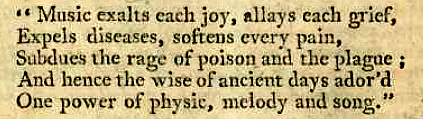 THE COLUMBIAN MAGAZINE, For FEBRUARY, 1789 THE COLUMBIAN MAGAZINE, For FEBRUARY, 1789 |
| |
more on musical grills
musical gridirons were illustrated
for 500 years |
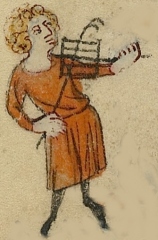 1320's gridiron played with a fishhook, France 1320's gridiron played with a fishhook, France
|
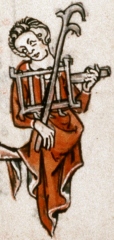 c. 1320-1330 gridiron played with a fishhook; psalter, Flanders, Ghent c. 1320-1330 gridiron played with a fishhook; psalter, Flanders, Ghent |
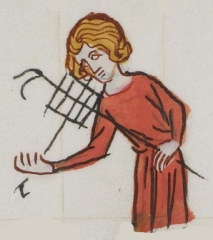 1330-1340 Paris, France 1330-1340 Paris, France
|
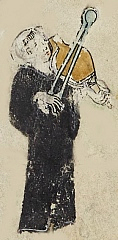
"Strange instruments made out
of everyday objects like
grills
and distaffs,...
mingle in
the grotesque
underworld
of marginal
miniatures,
in which
the noble art
of music
is often
replaced by
the cacophonous
noises suggested
by the devil"
‘The Parody of Musical Instruments in Medieval Iconography’
by Sandra.Pietrin, 2017
|
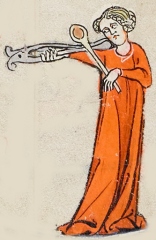 13th / 14th century jaw-bone 13th / 14th century jaw-bone
played with a wooden spoon, Flemish |
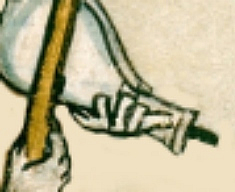
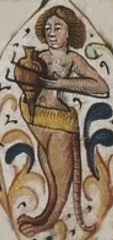
| bellows become bowed instruments or a fiddle-flute: |
|
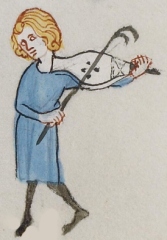 1330-1340 bellows and fishook, Paris 1330-1340 bellows and fishook, Paris
|
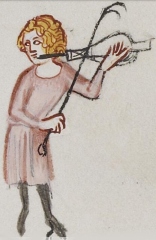 1325-1350 France 1325-1350 France
|
|
|
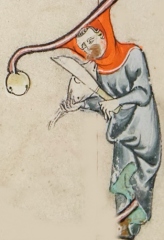 1300 bellows and knife played by a fool 1300 bellows and knife played by a fool
Flemish |
|
 |
 1470 France 1470 France |
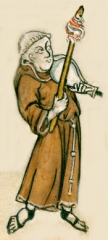
1300-1325 another bellows, not-a-viol, played by a monk, Liège, Belgium |
|
a rake is often used as a bow: 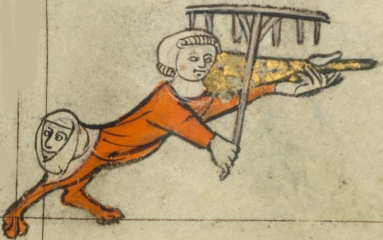 |
|
|
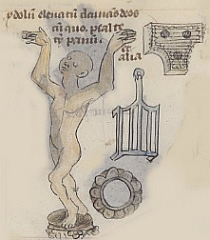
another example - grater:  1470 Flanders, probably in Bruges and Ghent 1470 Flanders, probably in Bruges and Ghent |
|
 before 1403 astrological treatise, Bruges; before 1403 astrological treatise, Bruges;
illustrated with other musical instruments |
 1450-1492 astrological treatise, copy, Flanders 1450-1492 astrological treatise, copy, Flanders |
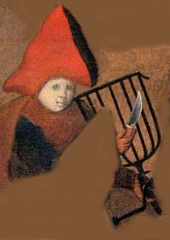 1559 representing 'carnival', Holland 1559 representing 'carnival', Holland |
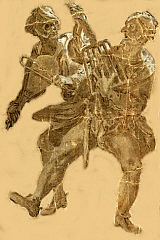 1564-1603 1564-1603 gridiron with bellows, Holland [ Z 775]
another version here |
|
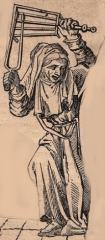 ‘An ancient barber-surgeon' caricature ‘An ancient barber-surgeon' caricature, England |
 1605 1605 satire on the catholic church, Holland |
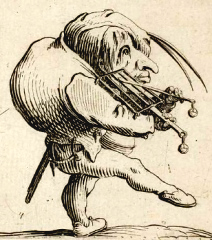 1616 copy of earlier image, France 1616 copy of earlier image, France
|
 1661 engraved glass goblet, Netherlands 1661 engraved glass goblet, Netherlands |
 1633 Holland [JvdVelde AB 3.16] 1633 Holland [JvdVelde AB 3.16] |
 1640 egg dance with kitchen implements band 1640 egg dance with kitchen implements band
Netherlands |
|
 1645 Holland 1645 Holland |
 1660 copy of 1619 original France 1660 copy of 1619 original France |
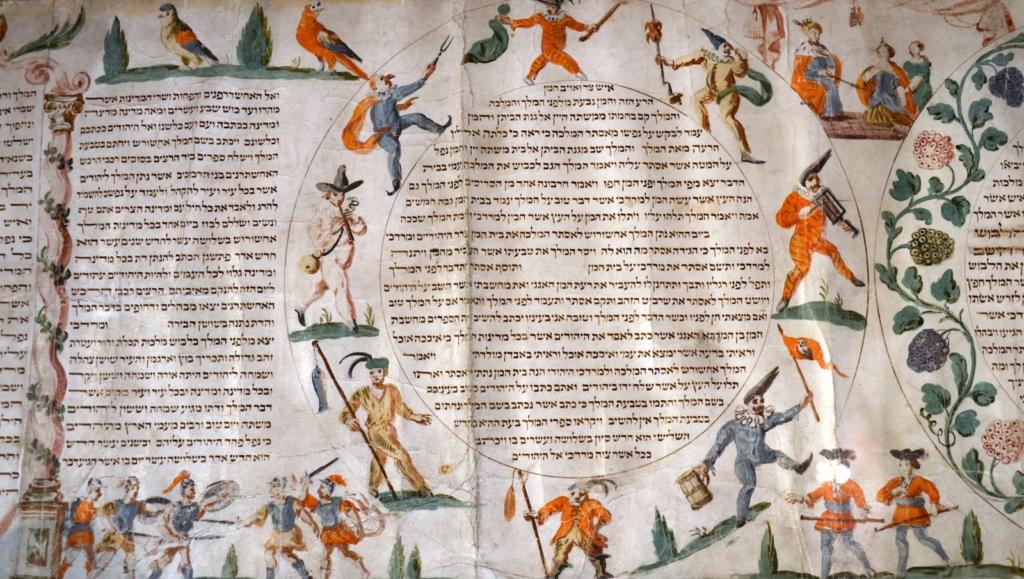
 c. 1675 Esther scroll Amsterdam, Netherlands c. 1675 Esther scroll Amsterdam, Netherlands |
|
1663 poem:
“…Round about it some were frisking,
Others on the Grass as brisking;
Most in Mirth, set hand to labour,
Tongs, and Gridiron, Trump, and Tabor…”
'Hudibras the second part' |
1697 opera
“Collin:
Well, and what Mucsik, what Gambols are ye to have Neighbour?
Clout: Why Fackins not much: but there will be the Pipe and Tabor, and Blind Will with his Dulcimer:
And then the Frying-Pan and Tongs. “
‘A new opera, call'd, Cinthia and Endimion: or, The loves of the deities. As it was designed to be acted at Court, before the late Queen
; and now acted at the Theatre Royal, by His Majesty's servants.’ The second edition. Written by Mr. D'Urfey. |
|
|
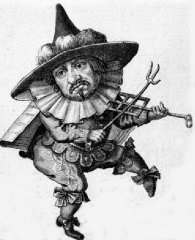 early 18th century calender, Germany early 18th century calender, Germany |
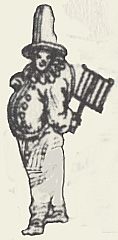 1723 masquerade costume, London, England 1723 masquerade costume, London, England |
|
 1742 playing for dancing, tile, Naples 1742 playing for dancing, tile, Naples |
|
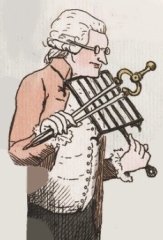 1786 satire, playing for dancing 1786 satire, playing for dancing
gridiron and tongs, London, England |
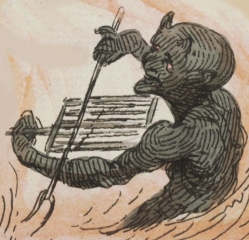 1787 demon plays the gridiron with a pitchfork 1787 demon plays the gridiron with a pitchfork
London, England |
 1830's 1830's
© Science Museum / Science & Society Picture Library |
|
|
|
|
 19th century statuette 19th century statuette |
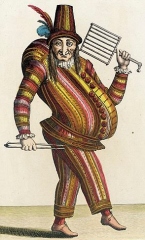
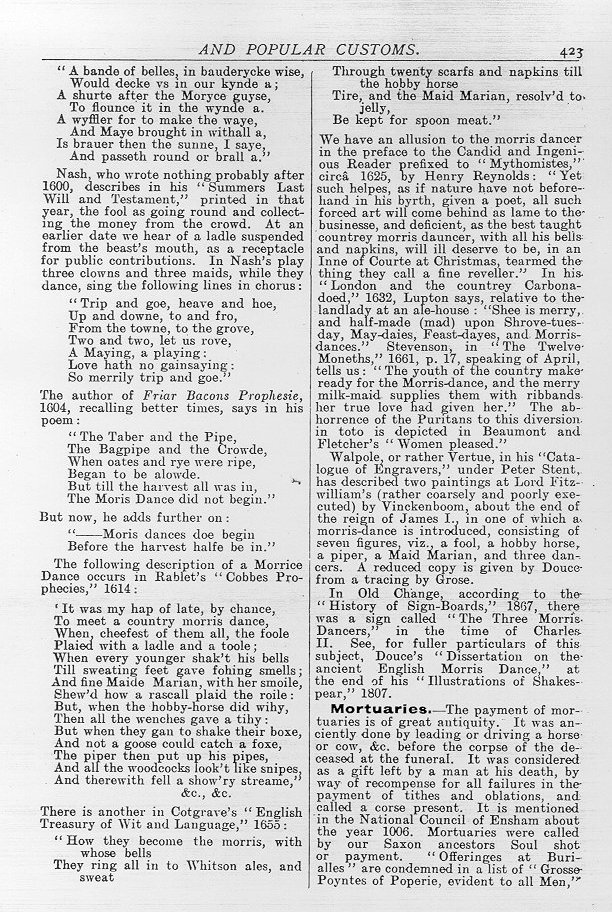
1893 memories of past sweeps parades in Cheltenham, England:
“I received some more information from Mr. Ames, a chimney-sweep living in Swindon Road, Cheltenham.
He says he used to go out along with them, and his father before him. … The gridiron on the clown's back
seems to be traditional;… There used to be pipe and tabbor..."
'The Jack-in-the-Green : a May Day custom' by
Judge, Roy |
parody on the pipe and tabor:  1469 Antwerp, Belgium 1469 Antwerp, Belgium |
 13th / 14th century bellows played
with tongs
13th / 14th century bellows played
with tongs 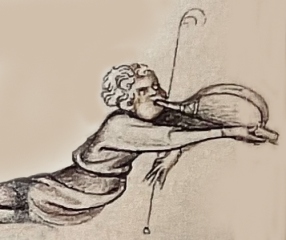 1324-1328 Paris, France 203r
  1325-1350 gridiron bowing a bellows, France
  c.1600 Holland
  17th century gridiron
  17th century painting, Austria
  18th century Book of Esther, Netherlands
  19th century statuette, Germany
  figurine in 17th century clothes