1599 In 'Much Ado About Nothing' by William Shakespeare (Act ii. Sc. 3)
Benedick speaks of the fife as less refined than the pipe.
“I have known, when there was no music with him
but the drum and fife; and now had he rather hear
the tabor and the pipe.” |
poem:
“…Then, why should I give way to grief?
Come, strike up pipe and tabor
He that affecteth God in chief,
And as himself his neighbour,
May still enjoy a happy life,
Although he lives by labor….”
'The Contented Man's Morice' by George Wither |
1605 and 1615 Don Quixote (published in two parts)
“...On the frontispiece, and on every quarter of the edifice, was inscribed, “ The Castle of Wise Reservedness.”
Four expert musicians played to them on pipe and tabour. Cupid began the dance…”
‘The History Of Quixote De La Mancha’
by Miguelde Cervantes Saavedra |
1606 play
“WILL CRICKET. Marry, to pretty Peg, Mistress Lelia's nurse's daughter.
O, 'tis the dapp'rest wench that ever danced after a Taber and pipe
For shee will so heele it, and toe it, and trip it,
O hir buttockes will quake like a custard..."
'Wily
Beguiled' "The Chiefe Actors be these: A poore Scholler, a rich Foole, and a Knave at a shift"e. |
1607 story: a dialogue set in Moore-fields, London, between "a Countrey Gentleman, and a London Citizen":
“… there is a long hollow Cesterne…there entereth divers labouring men, with Links and Torches lighted,
with a Taber and a pipe, or other such Mellody, that the Merchants, whose Vautes and Houses of offices
stand over, may hear them, and by such meanes they may know what is amisse, and wanteth mending …”
‘The pleasant walkes of Moore-fields Being the guift of two sisters, now beautified, to the continuing fame of this worthy citty’ by Richard Johnson |
1608 origin of the Pied Piper poem:
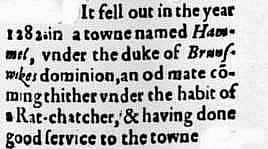
 ‘The Vanitie of the Eie’ by Hakewill, George ‘The Vanitie of the Eie’ by Hakewill, George |
1609
"The punning connection of the holy mount to the wicked musical instrument was not lost on the audience;
Henry Greenwood may have had the linkage in mind as he condemned “unrighteous” “hypocrites” who
“praise the Lord in the Tabor, but not in the dance.”
'MEETING, MERRIMENT, AND MASSACRE: MUSICAL ENCOUNTERS BETWEEN KIKOTANS AND ENGLISH, 1607-1610'
by Jeanne Eller McDougall |
1609-11 'The Winter's Tale' by William Shakespeare
"SERVANT. O master, if you did but hear the pedlar at the door,
you would never dance again after a tabor and pipe;..." |
1611 'The Tempest' by William Shakespeare, Act iii. Sc. 2
Stephano, says (before he starts a catch) :
" Come on, Trinculo, let us sing.
Sings Flout 'em and skout 'em, and skout 'em and flout 'em ;
Thought is free.'
Caliban. That's not the tune.
[Ariel, who is invisible, plays the tune on a tabor and pipe.)
Stephano. What is this same ?
Trinculo. This is the tune of our catch, played by the
picture of No-Body. " ...
Ariel moves off, at the same time playing so enchantingly that the conspirators are constrained to follow :
Trin. The sound is going away ; let's follow it. ...
Ste. Lead, monster ; we'll follow. I would I could see this tabourer ; he lays it on. |
1611 French proverb
"qui est venu par lafleute s'en retourne avec le Tabourin ; "
Prov. What the pipe hath gathered the Taber scattereth ; goods ill gotten are commonly ill spent.
Cotgraves Dictionary of the French and English Tongues quoted in: SIX LECTURES ON THE RECORDERAND OTHER
FLUTES IN RELATION TO LITERATURE BY CHRISTOPHER WELCH, 1911 |
1612 burlesque poem:
In a double entendre seen in other commentary on musical instruments, William Fennor
wrote of a man
being cuckolded by a “knave … playing frolickly upon his Tabor.”
“…An honest good plaine-dealing man of life,
Which got his living daily by his labour,
Finding a knave in sporting with his wife,
And playing frolickly upon his Tabor ,
Did not, as some would use to sweare & swagger,
And at the first sight stab him with his dagger;
But in good words he wisht they would amend,
And let him go, because he was his friend…”
‘Cornucopiæ, Pasquils night-cap: or, Antidot for the head-ache’ by Fennor, William. |
1613 song:
“With Shackbuts noate that pierce the skies,
With Pipe and Taberet,
What tunes by reedes or canes arise,
Do not His praise forget.”
Sir William Leighton (1613) 'The Teares or Lamentacions of a Sorrowfull Soul. Composed with musical ayres and songs,
both for voyces and divers instruments'. quoted in 'Old English instruments of music, their history and character' by Galpin, Francis W |
A long topographical poem written between 1613 and 1622, describes the beauties of the English landscape
and the life of the people as the poet saw it. Musical instruments of the period are mentioned including:
"...Some blow the Bagpipe up, that plays the Country-Round;
The Tabor and the Pipe some take delight to sound. .." |
1613 story:
“...Four skilful musicians played to them on a tabor and pipe; Cupid began the dance, and, after two changes,
he lifted up his eyes and bent his bow against a virgin that stood upon the battlements of the castle …..
the verse being ended, he shot a flight over the castle, and retired to his standing. By and by came out Money,
and performed his two changes; the tabor ceased, and he spoke:…..
At last, after Money had danced a good while, he drew out a great purse made of a Roman cat’s skin,
which seemed to be full of money, …..
they made show as if they would have rescued her; and all these
motions were to the sound of the tabors. With skilful dancing the savages parted them, who very speedily
went to set up and join the boards of the castle, and the damosel was there enclosed anew; and with this
the dance ended, to the great content of the spectators....”
'CHAPTER XX: Of the Marriage of Rich Camacho, and the Success of Poor Basilius' in The History of the Valorous & Witty Knight-Errant
Don Quixote of the Mancha by Miguel de Cervantes, Translated by Thomas Shelton |
1614 'ANTICK-MASQUE OF THE SONG'.
‘...SILENUS, an old fat man’ comes in, ....
Before SILENUS marched four singers.....
His music, a tabor and pipe, a base violin, a treble violin, a sackbut , a mandora...’
THE MASQUE OF FLOWERS, BY THE GENTLEMEN OF GRAY'S INN. AT THE COURT OF WHITEHALL,
IN THE BANQUETING HOUSE, UPON TWELFTH NIGHT, 1614. BEING THE LAST OF THE SOLEMNITIES
AND MAGNIFICENCES WHICH WERE PERFORMED AT THE MARRIAGE OF THE RIGHT HONOURABLE
THE EARL OF SOMERSET AND THE LADY FRANCES, DAUGHTER OF THE EARL OF SUFFOLK, LORD CHAMBERLAIN |
1618 play:
“…Where the Piper does find
A more delicate wind
To make his pipe sound more sweet:
Whiles his sticke does belabour
The head of his Tabour…”
So, now we want nothing but the Tabor wee talk't of: but 'tis no matter, since he does not come, wee'll sing,
and so make musike to our selves. Who can tune the Morrice best?
Enter an hobby horse dancing the Morrice and a Tabourer.
Music and runs away with the Tabourer
‘Technogamia: or The marriages of the arts. A comedie, written by Barten Holyday, Master of Arts, and student of Christ-Church
in Oxford, and acted by the students of the same house before the Universitie, at Shrove-tide’ by Barten Holyday |
1615-30 play
1.Man. … she hath promis’d me to meete me much about this houre in this very place,
and to bring two of her neighbours along with her, and a Tabor and Pipe, to give me
and any two I shall bring with me a meeting where we may trip it for an hour or two …
2. Wom. I can daunce with them too ; are you they, I pray you ? if you be, we have
brought a very feat Tabourer along with us.
2. Man. That you may know, pretty mayde, that we be the men you looke for, command
your Tabourer to strike up, and we two to any two of them.
3. Wom. Nay, we’ll all daunce, that’s sure, we’ll none sit by for looker’s on …
'The Partiall Law' Act 2, Scene 4 mentions seven dance tunes played on pipe and tabor. |
1620 poem
Terrible news for Taber and Pipe,
“AN odd companion, walking up and downe,
To pipe a living out from towne to towne:
Being at a Wedding busie at his play,
Forgetting danger of his tedious way.
Belated was, yet be it ill or good,
He did resolve to wander through a wood.
And as he went with knap-sacke full of scrapps,
And Taber at his backe,..
[Ed a bear chased him up a tree and he fed it with the wedding scraps]
Terrible news for Tabber and Pipe,
“… And so betakes him, to his Pipe and Tabor,
And doth them both, so sound and brave belabor,
The Beare amazed from his scratching runs
As if at's breech had bin a peale of guns,
Which when the Taborer with joy did see.
Well Beare (he said) if this your humor be,
Would I had knowne to use the charming feaste.
You should have daunc'd, before you had my meate
…The story of the Piper and the Beare,
Vowing his Tabor was more deere to him,…”
'The Night-Raven' by Samuel Rowlands |
1620 story:  ‘The Worth of a Penny: Or, a Caution to Keep Money. With the Causes of the Scarcity and Misery of the Want Thereof. As also how ‘The Worth of a Penny: Or, a Caution to Keep Money. With the Causes of the Scarcity and Misery of the Want Thereof. As also how
to save it , in our Diet , Apparel , Recreation , & c . Home And also what honest Courses Men in want may take to Live’ by Henry Peacham |
1620 play:
“These Reapers have the merriest lives, they have musicke to all they doe; they'l sow with a Tabor,
and get Children with a Pipe.”
‘A courtly masque: the device called the vvorld tost at tennis As it hath beene divers times presented to the contentment of many noble
and worthy spectators, by the prince his servants. Invented, and set downe, by Tho: Middleton & William Rowley gent.’ |
1621 court masque ‘The Gypsies Metamorphos'd’ and other masques by ben Jonson:
Pup. Musique ! wee’ll have a whole povertie of Pipers.
Call Cheekes upon the bagpipe, and Tom Ticklefoote with his tabour. Clod , will you gather the pipe monie ?
Clod . And Ticlefoot ha’s lost his Clowt, he sayes, with a three- pence and fower tokens in it,
besides his tabouring sticke, even now.
Then strike up your tabour,
And there’s for your labour.
Deny the bowd groate,
And you lie in your throate ;
Or the Tabourers nine pence,
Or the sixe fine pence.
I pray you give me leave, for I will study.
Though all the Bels, Pipes, Tabors, Timburines ring
That you can plant about me : I will study.
And each did dance, some to the Kit, or Crowd,
Some to the Bag-pipe, some the Tabret mov’d,
Commentary:
No indication is given of the girls’ entrance, but a country dance follows, in which they take part, to the music
of the pipe and tabor. …the taborer enters promptly with the wenches of Windsor.
Pipe and tabor is frequently recorded as being used in the masque, usually as part of a 'mock band' or 'wild music'
specifically to accompany such dances, giving them an antique and rustic air.
‘The Works Of Ben Jonson Volume-vii’ |
1622
poem
‘A Christmas Carroll’
“…And every lad is wondrous trimm,
And no man minds his labour,
Our lasses have provided them
A bag-pipe and a tabor….”
First published in ‘A Miscelany of Epigrams [&c.]’ appended to ‘Faire-Virtue, the Mistresse of Phil'Arete’,
generally bound with ‘Juvenilia’ by George Wither |
A contemporary writer's view of sports and pastimes... most prevalent in the seventeenth century:
“Dancing, singing, masking, mumming and stage plays are reasonable recreations in season ;
as are May-games, wakes, and Whitsun-ales, if not at unreasonable hours. Let the people
freely feast, sing, dance, have puppet-plays, hobbyhorses, tabours, crowds [fiddles] and bagpipes…”
‘REMAINS HISTORICAL & LITERARY CONNECTED WITH THE PALATINE COUNTIES OF LANCASTER AND CHESTER’,
PUBLISHED BY THE CHETHAM SOCIETY. VOL. XLVI, page 1006 |
1630 poem
“…Violins, strike up aloud,
Fly the Gitterne, scowre the Crowd,
Let the nimble hand belabour
The whisteling Pipe, and drumbling Taber :
To the full the Bagpiperacke,
Till the swelling leather cracke …”
‘‘The eight Nimphall’ - The Muses Elizium lately discovered, by a new way over Parnassus. The passages therein, being the subject of ten
sundry nymphalls,
leading three divine poemes, Noahs floud. Moses, his birth and miracles. David and Golia.’ by Michael Drayton Esquire. |
1632 play 'Twelth Night' by Shakespeare, William
"Clown sings to pipe and tabor"
‘The complete works : the text regulated by the old copies and by the recently discovered folio of 1632, containing early manuscript
emendations ; with notes, selected and original, a copious and almost new glossary, the poet's life and portrait', 1854 |
1633 poem
"...What now (alas) can Wake, or Faire availe
His love-sick minde? no Whitsunale can please,
No Jingling Morris-dances give him ease;
The Pipe and Tabor have no sound at all;
Nor to the May-pole can his measures call,
Although invited by the merryest Lasses..."
‘The reigne of King Henry the Second written in seaven bookes. By his Majesties command.’ |
1637 poem
“…Where Drum and Trumpet now affright,
The Pipe and Tabour may delight…”
‘Flos Britannicus veris novissimi’ by Oxford University. [British flower of late spring] |
1637 poem,
with the fagge-end of an old mans old will, who gave a good summe of mony to a Red-fac'd
Ale-drinker, who plaid upon a Pipe and Tabor, which was this:
"...To make your Pipe and Tabor keepe their sound,
And dye your Crimson tincture more profound,…”
'THE FAMOUS HISTORIE of the most part of Drinks, in use now in the Kingdomes of Great Brittaine
and Ireland; with an especiall
declaration of the potency, vertue, and operation of our English ALE.
Compiled first in the high Dutch tongue, by the painefull
and industrious Huldricke Van Speagle,
a Gramaticall Brewer of Lubeck, and now most Learnedly enlarged, amplified, and Translated
into English by John Taylor ‘
|
poem: "Verse 3:
...Twixt widowes and maids there is a great strife,
And either of them would faine be a wife,
They all doe cry out on this fond single life,
And long to dance after a Taber and Fife.. ..."
'A PEPYSIAN GARLAND BLACK-LETTER BROADSIDE BALLADS OF THE YEARS 1595-1639
CHIEFLY FROM THE COLLECTION OF SAMUEL PEPYS' page 235 |
1640 treatise on melancholy:
“…Like th' fellow that tell's billets out, or rather Like him, that playes (without a pipe) o' th' Tabor…”
‘Erōtomania or A treatise discoursing of the essence, causes, symptomes, prognosticks, and cure of love, or erotique melancholy’
Written by Iames Ferrand Dr. of Physick |
1640 play: Tom Ticklefoot is a taborer.
“…Cock. We must have some musick then.
Pup. Musick! we'll have a whole poverty of Pipers, call Cheeks upon the Bag-pipes, & Tom Ticklefoot
with his Tabor ; he could have mustred up the smocks o'th two shires; and set the Cod pieces and they
by the eares, I wusse, here's my two-pence towards it:
Clod will you gather the Pipe money? …”
…
Town. Harke, now they treat upon Tickle-foot.
4 GYPSIE. On Sundayes you rob the poores boxe with your Tabor. The Collecters would doe it,
you save them a labour….”
...
Clod. And Ticklefoote has lost his Clout he sayes, with a three-pence and foure tokens in it, beside
his Tabouring stick, even now.
song: "Then strike up your Tabour, And there's for your labour...
Deny the bow'd groat, And you lye in your throat, Or the Tabourers nine-pence,"
‘Horatius Flaccus: his Art of poetry. Englished by Ben: Jonson. With other workes of the author, never printed before’
'
THE GYPSIES METAMORPHOS'D'
|
1644 crticism
“… we might, … sanctifie the same day with a Taber , and a Pipe, or after a more heathenish manner: …”
‘A short letter modestly intreating a friends judgement upon Mr. Edwards, his booke he calleth an Anti-apologie, with a large but modest
answer thereunto framed, in desire, with such evennesse of hand, and uprightnesse of heart, as that no godly man might be effended at it :
and with soule-desire also, that they, who are contrary-minded, might not be offended neither, but instructed.’ by Ezekias Woodward |
1644 essay
“… These people were so delighted in dauncing, That they taught their horses to daunce: So when the horses
heard the Trumpet and the Drum, they thought it was the Taber and the Pipe, so the horses fell to dauncing,
and gave up their Riders to the spoile… “
‘A dialogue, arguing that arch-bishops, bishops, curates, neuters, are to be cut-off by the law of God; therefore all these, with their service,
are to be castout by the law of the land. Notwithstanding, the world pleads for their own, why some bishops should be spared; the government
maintained; the name had in honour still; but the word of God is cleare against all this, for the casting-of-all-forth. The great question is, which
way of government now? For two wayes are contended for, The Presbyteriall and Independent: something is said to both these wayes: but we
have a sure word for it, that these two wayes are but in shew two, and will assuredly meet in one. Neuters are shewen openly here, and the curse
of God upon them. Presented to the Assembly of Divines.’ by Ezekias Woodward |
1646 letter:
“…I write not this that you should think I value these pleasures above those of Milcot: for I must here protest,
I preferre the single Tabor and Pipe in the great Hall, far above them…”
‘Fragmenta aurea A collection of all the incomparable peeces, written by Sir John Suckling. And published by a friend to perpetuate his memory.
Printed by his owne copies. by Suckling, John, Sir |
1647 ‘THE ARMIES LETANIE, Imploring the Blessing of God on the present proceedings of the Armie.’
“…repudiated puritans who wanted to save the nation `From May-poles and Fidlers and all that is Jolly'.
[Fidler - another name for a musician who might be playing the pipe and tabor] |
1647 ballad
‘A proper new Ballad, intituled The Fairies farewel, or God a mercy Will, to be sung or whistled,
to the tune of the Medow Brow by the learned, by the unlearned to the tune of Fortune.’
“…When Tom came home from labour, —
Or Cisse to milking Rose;
Then merrily went their Tabor
And nimbly went their Toes….”
"Certain elegant poems, written by Dr. Corbet, Bishop of Norwich." |
1647 poem
“…Green Cowcumbers, that on their stalks decline:
The Gardens Guardian, with no dreadful look,
Nor other weapon than a pruning-hook.
Tabor and Pipe come hither: see, alasse,
Thy tir'd Beast sweats; spare him; our wel-lov'd Asse….”
‘The Hostesse’ by Thomas Stanley |
"...But I doe hope once more the day will come,
That you shall mount and pearch your cocks as high
As ere you did, and that the pipe and drum
Shall bid defiance to your enemy;
And that all fidlers, which in corners lurke,
And have been almost starv’d for want of worke,
Shall draw their crowds, and, at your exaltation,
Play many a fit of merry recreation. ..."
Hone The Everyday Book 1826, May 1st |
1651 burlesque 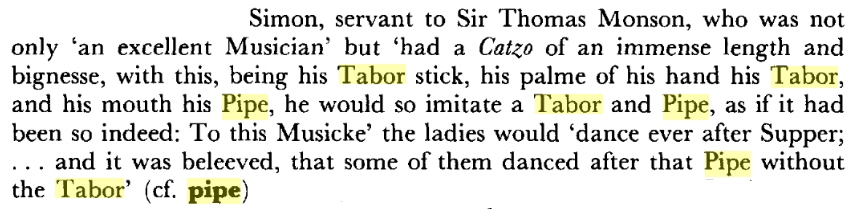 'The Court and Character of King James. Whereunto Is Now Added the Court of King Charles: 'The Court and Character of King James. Whereunto Is Now Added the Court of King Charles:
Continued Unto the Beginning of These Unhappy Times' by Anthony Weldon. |
1653 “…What shall I doe for to asswage my misery? tell me, seeing I have already related my chance.
The Eccho answered, dance. Sing then, or whistle, or play on the Tabor …”
"The extravagant shepherd, the anti-romance, or, The history of the shepherd Lysis translated out of French." by Sorel, Charles |
1654
“They come all like Gypsies or a Morrice, and Dulcinea is pleas'd to be Mayd Myriam; Strike up the Tabor
and the Pipe, lend us but the Barne, or the Church-house…”
‘Pleasant notes upon Don Quixot’ by Edmund Gayton, Esq. |
1655 “The Vision of Visions declaring out of the Prophet Daniel the coming of the fifth Monarchy, the renewing
of all Musical instruments, as Organs, Cornets, Tabor and Pipe, for to rejoyce the hearts of all old Christians,
and the fall of Babylon the great”
‘Mr. Evans and Mr. Penningtons prophesie: concerning seven yeers of plenty, and seven yeers of famine and pestilence.
Fore-shewing,
what strange events and effects will fall in this present yeer, 1655, now the seven years of plenty are past,
and the seven yeers of famine
and pestilence are now at hand. Declared in vision of visions out of the prophet David. Together with the coming of the Fifth monarchy.
Also, a great conflict with that great and terrible dragon Satan. With divers other notable visions and revelations necessary to be published.’
by Evans, Arise |
1656 published masque:
“Venus and Adonis.: A Masque. The Frontispiece was a thick-grown Wood, repleat with Lions, Tygers, Bears,
Antilopes, Panthers, and other Beasts of prey; Sylvanus, Priapus, Pan, and other Wood-Gods, cracking
of Nuts, and eating of Apples, while the following Song was sung to the Tabor ...."
‘Don Zara del Fogo a mock-romance / written originally in the Brittish tongue, and made English by a person of much honor, Basilius Musophilus ;
with a marginall comment, expounding the hard things of the history’ by Holland, Samuel, gent. |
1656 poem regarding Satan's influence:
“…Tell me how curst an egging with a sting
Of lust doe these unwily dances bring,
The simple wretches say they mean no harme
They don't indeed, but yet those actions warme
Our purer blood the more: For Satan thus
Tempts us the more that are more righteous.
…
Sounds not the Pulpit then which we belabor
Better and holier then doth a Tabor ;
Yet such is unregenerate mans folly,
He loves the wicked noyse, and hates the holy…”
‘Parnassus biceps. Or Severall choice pieces of poetry, composed
by the best wits that were in both the universities before their
dissolution.
With an epistle in the behalfe of those now doubly
secluded and sequestred Members, by one who himselfe is none.’ |
1656 song about rural workers dancing:
“…Dick the plow-boy, and Joane of the Dary,
To solace their lives & to sweeten their labor
They met on a time with a pipe and a tabor”…
‘Wit and drollery,: joviall poems. Never before printed. /
By Sir J.M. Ja:S. Sir W.D. J.D. and other admirable wits’.
page 136 |
1657 an entertainment:
“they all intermix'd and danc'd the Hay…After they had thus danc'd awhile…there happen'd a pleasant dispute
for some time, to the Flute and Tabor , perform'd with great agility and exactness, till they were at length
parted by the Savages, and so the Show ended, to the great satisfaction, and with the high Applause of all the Spectators."
‘The history of the most renowned Don Quixote of Mancha and his trusty squire Sancho Pancha now made English according to the humour
of our modern language and adorned with copper plates by J.P.’ by Cervantes Saavedra, Miguel de, page 388 |
1658 poem ‘Voila Ma Vie’
(a Cavalier’s Creed .)
“To him whose hardest toil seems play,
Since well he loves his labour,
Life gives continual holiday,
While Time plays pipe and tabor….”
‘Cavalier lyrics: for church and crown'
by Joseph Woodfall Ebsworth, 1887 |
1659 proverb:
F
“That which came by the Pipe, goes away by the Tabor”
'Paroimiographia Proverbs, or, Old sayed savves & adages in English
(or the Saxon toung), Italian, French, and Spanish, whereunto the British
for their great antiquity and weight are added ..' collected by James Howell Esq |
1659 play
“… The Witny finger's are but chattering magpie's to this melodious Nightingale, and the Taber and Pipe,
but as the scraping on a brasse pan to this Organ …”
‘The London chaunticleres a witty comoedy full of various and delightfull mirth.’ |
1660 hope for the restoration of church order in which:
“...None then shall Organs hate, all Organs be;
Made instrumentall in the serving thee.
No nose tun'd Parson th' Pulpit shall belabour
With noise resembling the Scotch Pipe and Tabor...”
‘Itur satyricum [Let's go satirical] in loyall stanzas’ by John Collop |
1660 poem: verse 7.
“Then why should I give way to grief?
Come, strike up Pipe and Tabor ;
He that affecteth GOD in chief,
and as Himself his Neighbour,
May still enjoy a happy life,
although he lives by labour.”
‘Speculum speculativum, or, A considering-glasse being an inspection
into the present and late sad condition of these nations : with some cautional expressions made thereupon / by George Wither, immediately after
His Majesties restauration, to preserve in himself and others
a Christian
obedience to God's various dispensations ; hereby also
are some glimmerings discovered of what will probably ensue hereafter.’
by George Wither |
1661 the month of July:
“The Pipe and the Tabor now follow the Markets, and he that hath money gets many a good Penny-worth.”
‘The twelve moneths, or, A pleasant and profitable discourse of every action, whether of labour or recreation, proper
to each particular moneth
branched into directions relating to husbandry, as plowing, sowing, gardening, planting,
transplanting ... as also, of recreations as hunting, hawking,
fishing, fowling, coursing, cockfighting : to which likewise
is added a necessary advice touching physick ... : lastly, every moneth is shut up with
an epigrame : with the fairs
of every month’ by M. Stevenson. |
1663 poem:
“…Round about it some were frisking,
Others on the Grass as brisking;
Most in Mirth, set hand to labour,
Tongs, and Gridiron, Trump, and Tabor…”
...
“…To this Town People did repair
On dayes of Market, or of Fair,
And to crack'd Fiddle, and hoarse Tabor
In merriment did drudge and labour:…”
'Hudibras written in the time of the late wars.' by Samuel Butler |
1665 poem
“…Not far from thence good people there is
A Country House of Farmer Ceres,
Where hobnayl'd Louts do use to labour
And thrash a Gig to Pipe and Tabor…”
;
‘Scarronides, or, Virgile travestie a mock-poem being the second book
of Virgils Æneis translated into English burlesq : being a continuation
of the former story’ by R. Monsey
|
17th century burlesque 'A Mock Poem' 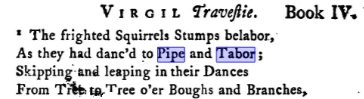 ‘The genuine poetical works of Charles Cotton, esq; containing, I. Scarronides: or, Virgil travestie. II…. ‘The genuine poetical works of Charles Cotton, esq; containing, I. Scarronides: or, Virgil travestie. II…. |
1666 story: 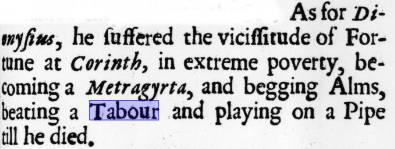 ‘His various history’ by Ælianus, Claudius. Chapter VIII ‘His various history’ by Ælianus, Claudius. Chapter VIII |
1667 poem
“…All night sometimes she is out
At some great bodies labour,
She nimble whisks about,
As 'twere at a Pipe and a Tabor…”
‘Folly in print, or, A book of rymes’ by John Raymond |
1670 translated Spanish story:
“…A while after, dyed one of the principal men of the parish, a Gentleman and of good Parentage: But a person
that would make a fool of himself, when he was in his Wine, so that being a little elevated, would go out upon a holy
-day with a Tabor and Pipe, to make merry and dance with the maids and young men of the Town, in a ridiculous manner…”
‘The fortunate fool' written in Spanish by Don Alonso Geronimo de Salas Barbadillo of Madrid |
1673 comments on his religious tract called 'Rehearsals transpros'd’ :
“…So to crack'd Pipe and broken Tabor ,
In Merriment Clowns Drudge and Labour…”
‘S'too him, Bayes, or, Some observations upon the humour of writing Rehearsals transpros'd’ by Andrew Marvell
|
1674 story
‘The Zealous Soldier’.
"A certain Switzer, a Soldier and Roman Catholick, being in France, was solicited by some French Gentlemen
to go with them into Holland ….and commanding him to be disarmed furnished him with Tabor and Pipe,
with several antick baubles; saying,
Go Soldier since thou wilt not bear Armes against the Catholicks, carry
these pretty knacks to them…”
‘The Complaisant companion, or, New jests, witty reparties, bulls, rhodomontado's, and pleasant novels’ |
1675 ' Burlesque'
 ‘Burlesque upon burlesque, or, The scoffer scoft being some of Lucians dialogues, newly put into English ‘Burlesque upon burlesque, or, The scoffer scoft being some of Lucians dialogues, newly put into English
fustian for the consolation of those who had rather laugh and be merry, then be merry and wise’ by Charles Cotton |
1677 poem:
“…The Country Swain that is always in labour
And ne're knew no Joys but a Pipe and a Tabor …”
‘The wits academy, or, The muses delight consisting of merry dialogues upon various occasions composed of mirth, wit, and eloquence,
for a help to discourse to such as have had but small converse with the critical sort of people, which live in this censorious age : as also,
divers sorts of letters upon several occasions both merry and jocose, helpful for the inexpert to imitate, and pleasant to those of better
judgement, at their own leisure to peruse : with a perfect collection of all the newest and best songs, and catches, that are, and have been
lately in request at court, and both the theatres.’ |
1678 play:
“…we met a Company of fellowes attended by a blind Harper, and a Taber and Pipe, they were bringing along
3 or 4 Bears that were the next day to be baited … the noise that the blind Harper, and Taber and Pipe made,
my Master bawling, the Whore singing, and I quarelling among the Boyes…”
‘Trick for trick, or, The debauch'd hypocrite a comedy, as it is acted at the Theatre-Royal by His Majestie's servants’ by Tho. Durfey |
1679 Court trial observations:
“…I retired some time before my Master's death, in which Retirement, as Barbers having nothing to do, learn
to play on the Cittern, I got a stroke upon the Pipe and Tabor , by which means I now live very comfortably…”
‘Some observations upon the late tryals of Sir George Wakeman, Corker and Marshal [i.e. William Cuthbert Wall], &c.
by Tom Tickle-foot the taborer, late clerk to Justice Clodpate.’ by Francis Smith |
1679
“…I'me sure there will be no sport there till Tom Ticklefoot comes with his Tabour and Whistle….
I'me Master o' more Shillings now, since I was my own Master, than I was o' Pence when I was your Servant;
and I protest I get more by Tickling my Tabour , than ever you got by Tickling a Point o' Law in all your Life…”
‘Clod-pate's ghost, or, A dialogue between Justice Clod-Pate and his [quondam] clerk honest Tom Ticklefoot wherein is faithfullly
related all the news from purgatory, about Ireland, Langhorn, &c’ by Francis Smith |
DIALOGUE.
Apollo and Mercury, page 121
"But scarcely was he gone an Acre,
When in slips Captain Cuckold-maker,
And whips me into Bed to's wife,
Where whilst she whistled on the Fife,
He beat (Oh never such a Drum!)
A point of War upon her Bum.
Now as they thus, with pleasing labour,
Did jump and jigg to Pipe, and Tabour," |
Juno and Jupiter, page 126
"With a loud Crew of hair-brain-Jades;
A knot of very fine Comrades:
Yet good enough for him they be,
And far more Masculine than he:
Whilst to their Tabors, and their Pipes;
He jolts about his swagging Tripes,
With his hair crisp't so neat and fine,
And crown'd with Chaplets of the Vine,
More like a Morris-dancer far,
Than any Son of Jupiter. " |
1682 an allegorical novel by John Bunyan:
"So they were bid rise up, and go to the town, and tell to Mansoul what the Prince had done.
He commanded also that one with a pipe and tabor should go and play before them all the
way into the town...he sent them away to their home with pipe and tabor going before them...
they went down to the
camp with heavy hearts, but came back again with pipe and tabor playing
before them... but of the
Prince’s mercy, and sent home with pipe and tabor..... the Prince had
sent home the three prisoners
of Mansoul with joy, and pipe and tabor...”
‘THE HOLY WAR Made by Shaddai upon Diabolus
for the Regaining of the Metropolis of the World or The Losing and Taking Again of the Town of Mansoul,’ ch 7 |
1683 poem
“…Those friends whom most her suff'rings cou'd shock.
The Loves and Graces — were with Woodcock,
Pan busy at his pipe and tabor.
And all the Muses— Were in labour,…”
An Epistle from William Lord Russell: Written in Newgate, on Friday Night, July 20th, 1683 |
1684 how to deal with the rabble:
“…Thus may we deal with the foolish and impolitick Rabble of this Nation, as the Ratcatcher did with the Children
of Hamlin, allure them with Tabor and Pipe, with empty sounds, and ratling pretences…”
‘The visions of government wherein the antimonarchical principles and practices of all fanatical commonwealths-men and Jesuitical politicians
are discovered, confuted, and exposed’ THE THIRD VISION OF GOVERNMENT. (BOOK 3) by Edward Pettit |
1684 story
“…before he was fast asleep, Reynardine told his Son, that after his Father had slept four hours he must awaken him,
not with any jogging, noise, or violence, but gently and sweetly with a Tabor and Pipe, at first plaid upon very softly,
and afterwards louder and louder, till he should be fully and well awakned. This the Young Lord promised, and so
dismissed the Fox…the Fox's Counsel was forgot, till he was stark dead, cold and stiff. Then they knew too well
that the Tabor and Pipe could be of no use at all."
‘The Shifts of Reynardine the son of Reynard the Fox, or, A pleasant history of his life and death full of variety, etc. and may fitly
be applied to the late times : now published for the reformation of mens manners.’ |
1680's satirical poem:
"..A dancing Baboon, yclep'd Heraclitus,
With Tabor and Pipe began to delight us....”
‘Anecdotes Illustrative of the Manners and History of Europe ‘...by James Peller Malcolm, 1811 |
1684 dialogue between Juno and Jupiter:
“…And what's more strange , is, he hath perform'd all this amidst revelling, skipping and dancing
with Women, to the sound of Pipe and Tabour, and -—- commonly drunk to boot….”
‘Lucian's Works' |
1685 poem
“…Had I rich Croesus Wealth and mighty Store,
In Venus Temple should our Statues stand,
Thou with thy Pipe and Taber in thy hand,
I in a Dancer's Posture, gay, new shod,
Form'd of pure Gold, and glorious as a God! …”
‘Sylvæ, or, The second part of Poetical miscellanies’ by John Dryden |
1685-1687 song
“Come, come away, let's to the May-Pole go, and see what Lads and Lasses there may dancing be; …for Shame
still attends Sloth, and ought to be blam'd; make hast to see how they trip it to the Tabor…”
‘A Pastoral Song upon a Ground’ in ‘The theater of music, or, A choice collection of the newest and best songs sung at the court and public theatres
the words composed by the most ingenious wits of the age, and set to music by the greatest masters in that science : with a theorbo-bass to each song
for the theorbo or bass-viol : also symphonies and retornels in 3 parts to several of them for the violins and flutes.’ |
1687 poem
“…Sounds not the Pulpit then which we belabor
Better, and holier then doth a Tabor ?
Yet such is Unregenerate Mans Folly,
He loves the wicked Noise, and hates the Holy….”
‘The works of Mr. John Cleveland containing his poems, orations, epistles, collected into one volume, with the life of the author.’ by John Cleveland |
1690 play: 
‘The English Frier: or, the Town Sparks : A Comedy : as it is Acted by Their Majesties Servants’ by Crowne, John |
1690 poem ' A NEW ESSAY IN DEFENCE OF VERSE, WITH A SATYR UPON THE ENEMIES OF POETRY'
“…So many whimsies in the Nation raigns:
Hence Pipe and Tabor , Hum and Buz, are priz'd,
And each inspiring Muse as much despis'd….”
‘New poems, consisting of satyrs, elegies, and odes together with a choice collection of the newest court songs set to musick
by the best masters of the age / all written by Mr. D'Urfey.’ page 14 |
about 1691 'An Answer to Harvest Home : a true character of such countrymen who glory in cheating the vicar,
and prefer bag-pudding and dumpling before religion and learning.'
" ...Tell them of going to Church to pray,
They'd rather hear Robin the Piper play : . . .
Their hungry appetite to suffice,
Bag-pudding and dumpling they idolize. . . .
Likewise, by the laws of this potent land,
They in the pillory ought to stand...." |
1691 play [with a a sexual reference]
“… if you dare venture, you shall finde I can play on Taber and Fife still, Madam …”
‘Greenwich-park a comedy acted at the Theatre-Royal, by Their Majesties servants’ by William Mountfort. |
1691 Plutarch translation:
"The Samian minstrels and morris-dancers, such as were Aristonica, Oenanthe with her tabor and pipe"
‘Plutarch's morals. Part 4.’ Amatorius 9 translated from the Greek by several hands.
Also translated as " The Samian flute-girls and dancing girls, such as were Aristonica, Oinanthe with her tabor" |
1694 letter to a brother:
“…They say All is done, and there is nothing to be done only to Praise God. They had for their Musick a Violin,
Tabor and Pipe…”
‘A letter from a gentleman in Buckinghamshire near Water-Stratford. To his brother Mr. Thomas Pickfat at the Three Kings in White-cross-street,
in London. Giving an account of the doctrine and ... the behaviour of Mr. Mason ... with the hymns they usually sing.’ |
1695 play
“EPILOGUE.
From Elbow Chair i'th' Pantry I am come,
To see what you are doing here; make room.
So heartily I slept after my Labor,
My Nose did louder Musick make than Pipe and Tabor….”
‘The Canterbury guests, or, A bargain broken a comedy : acted at the Theatre-Royal / written by Mr. Edward Ravenscroft.’ |
1697 opera
“…Collin:
Well, and what Mucsik, what Gambols are ye to have Neighbour?
Clout: Why Fackins not much: but there will be the Pipe and Tabor, and Blind Will with his Dulcimer:
And then the Frying-Pan and Tongs. “
‘A new opera, call'd, Cinthia and Endimion: or, The loves of the deities. As it was designed to be acted at Court, before the late Queen
; and now acted at the Theatre Royal, by His Majesty's servants.’ The second edition. Written by Mr. D'Urfey. |
1697 play
Roger. To Sollace their Hearts, and to Sweeten their Labour,
Wench. All met on a time with a Pipe and a Tabor .
‘The intrigues at Versailles, or, A jilt in all humours a comedy : acted by His Majesty's servants at the theatre in Lincolns-Inn-Fields' by Mr. D'Urfey |
1700 poem:  The London Spy 1700-03: Vol 2 The London Spy 1700-03: Vol 2 |
1700 song
“…With our Labor,
Pipe and Tabor;
We's play on each new born Year:
Jenny'l peddle,Sawny'l fiddle,
Sing and dance;
Take our Chance
Laugh, drink, and drown the Worlds Care.”
‘A scotch song' written and compos'd by Mr. Richard Brown.’ |