In the 16th century neither terminology nor spelling were fixed.
So a pipe and tabor player could be,
for example,
a
mynstrell, a musician, a drummer, a pyper, taber and piper, tabret, taberette or a fidler.
It is impossible to know now
which of
some of these are taborers or players of other instruments as
seen in contemporary images. |
| |
taboring is evil |
1581
John Marbeck (author and composer) saw good in the instruments but evil in some of its users. He stated that,
“The wicked runne after the Tabor and the Flute,”
1582 According to many of its critics, the remedy for the evil of taboring could be found in religion. The master
in Christopher Fetherston’s dialogue against dancing cautions his student:
“to reioyce, not in a bawdy pype or tabor, but in the Lorde.” |
1600 Puritans believed that minstrelsy harmed one’s spiritual health:
Philip Wyot of Barnstaple noted in his diary that the local vicar was found in the alehouse ‘as usuall’, by the mayor
and aldermen. The vicar and his cohorts had ‘amongst them a pip with a Taber a little after nine’. The vicar was
arrested and committed by the mayor
‘Thomas Whythorne and Tudor Musicians’ by Katie M. Nelson, 2010, page 147 |
| |
London:
1501 payment in the Carpenters wardens accounts to a taborer for the London Midsummer watch – a large procession
1501 Drapers wardens accounts show payment for a taborer to play on a barge
1502 skinners list a payment to a taborer for waiting on the watch
‘The Tabor: Original Morris Instrument?’ - Dr Kathryn Roberts Parker |
1509
" There sate dame musyke with all her mynstralsy
As tabours, trompettes with pypes melodyous"
'Dictionary of Middle English Musical Terms'.Carter, H.H. (1961/1980) Indiana University Press, Bloomington. Reprinted (1980). |
1518 dispute over processions of workmen at harvest time etc.in Gloucestershire, led by town's 'tabourer',
to High Cross to drink.
Agreement, 1518, settling the dispute
The National Archive GBR/B/8/7 Town Clerk’s legal papers |
1530
John Palsgrave (c. 1480 – 1551) had a dictionay printed in London dedicated to Henry VIII.
'L'esclarcissement de la langue francoyse', was written in English, despite its French title. Its purpose was to help
Englishmen who wanted to learn French. [details here] |
From 1531 various acts were passed aimed at limiting the movement of the poor. … Independent musicians
would have continued playing in the usual alehouses, inns and private settings, but, after the Vagrancy Act (1572),
their limited freedom to move around must have severely restricted their earnings. After 1600 the number
of prosecutions of musicians in court records rises.
Norwich sometimes paid performers not to perform, although in one case the performers took the money
and then performed anyway, leading to a threat of imprisonment if they returned. After the coming into force
of an act in 1589, the number of refusals to perform increases. That piece of legislation was aimed at diminishing
the number of people attending performances on the sabbath. Initially the city seems to be fairly lax, and did not
enforce the law.
‘POPULAR MUSIC AND MUSICAL SOUND IN EARLY MODERN ENGLAND: NOISE, MUSICIANS AND WORDS,
1550 TO 1650’. by: Joe Higham, 2014 |
1565 dictionary 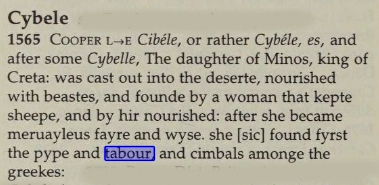 ‘An early music dictionary : musical terms from British sources, 1500-1740’
by Strahle, Graham 1995 ‘An early music dictionary : musical terms from British sources, 1500-1740’
by Strahle, Graham 1995 |
1565 Letter from Randolph to Cecil regarding Queen Elizabeth I music in church:
" Organs were wont to be the common music. She wanted now neither trumpet, drum, nor fife, bagpipe, nor tabor.”
Calendar of State Papers Foreign: Elizabeth, Volume 7, 1564-1565. |
1575 song
“… they affirmed that to play in plague-time was to spread infection, and to play out of plague-time was to breed it.
It was consequently ordained that the players—who, “ if they were not her majesty’s servants, should by profession
be rogues”—must perform only at weddings and private festivals, and only act in London during the very healthiest
season…
...Without a pipe and tabour
They only mean to labour
To teach each ox-hide neighbour.
This is the cause and reason,
At every time and season,
That plays are worse than treason….”
'GOING TO THE PLAY WITH SHAKESPEARE',All the Year Round 1862-01-11: Vol 6 Iss 142 |
1577 diary entry, May Day at Bradgate, Leicestershire
"Then, when the merrie May Pole and alle the painted Morris-dancers, withe Tabor and Pipe, beganne
their spritelie anticks on our butiful grene laune, a fore that we idel leetel Bodyes had left owre warme
Bedds, woulde goode Mistress Bridget, the Tire-woman whom our Lady Mother alwaies commanded
to do owre Biddings, com and telle us of the merrie men a-dancing on the Grrene."
‘The Tablette Booke of Ladye Mary Keyes: Owne Sister to the Misfortunate Ladye Jane Dudlie ; in Wiche Wille be Founde a
Faithefulle Historie of Alle the Troubels that Did com to Them and Theire Kinsfolke, Writt is the Yeare of Oure Lorde Fifteene
Hundred and Seventie-seven’ Printed 1604, page 3 Quoted in Publications of the Folk-lore Society |
1595 court case:
“John Grene, summoned to the church court at Manchester in 1595 for making an ale on a Sunday,
was charged at the same time with piping on the sabbath day one week later” |
1579 Cambridgeshire, Diocese of Ely,
Bishop Richard Cox's Injunctions:
“ITem bicause the Saboth day is so fondly abused in going unto Fayers and visiting of frendes, and acquaintances,
and in feasting and making of good chere, in wanton dawnsing, in lewd maygames sometyme continuing riotously
with Piping all whole nightes in barnes and such odde places, both younge men and women out of their fathers
and masters howses, I charge all my parishes, within my Dioces, and charge the Churchwardens, Sidemen,
and ministers to see that no such disorders be kept upon the Sabaoth day, commonly called the sundayes,
as they will aunswere uppon their othe.” |
1582 book
‘On the properties of things’
“divers instruments serve to this maner harmonie, as Taber & Timbrel, Harpe and Psalterie, and Nakyres …
TImpanum is layde straight to ye trée in the one side: and is halfe a Taber, or halfe a Simphonie, & shapen
as a s••e, and braten with a sticke, right as a Taber… and maketh the better melodie if there be a pipe therewith….”
Batman uppon Bartholome his booke’ De proprietatibus rerum’, newly corrected, enlarged and amended: with such additions as are requisite,
unto every severall booke: taken foorth of the most approved authors, the like heretofore not translated in English. Profitable for all estates,
as well for the benefite of the mind as the bodie. 1582. |
1584 collecting money to repair the church:  described around 1710 and quoted in ‘The Ancient English Morris Dance’ by Michael Heaney described around 1710 and quoted in ‘The Ancient English Morris Dance’ by Michael Heaney |
1590 Lincoln - an attempt by the city sponsored band (waites) to stop other musicians from working in their town:
“ Jan. 19.—At the suit of the waits it is ordered that no musicians except the waits do hereafter play
at any marriages, unless such musicians give to the waits 2s. for every marriage they play at. “
'The Corporation of Lincoln: Registers, vol. IV (1564-99)', in The Manuscripts of Lincoln, Bury St. Edmunds Etc. Fourteenth Report’ |
“On occasion it was necessary for cities to hire additional musicians to help the waits at major performances.
Exeter hired a pipe and tabor to help the waits at their Lammas fair;”
‘Thomas Whythorne and Tudor Musicians’ by Katie M. Nelson, 2010, page 171 |
1592 High Commission Order for the Suppression of Entertainments:
“…beinge led awaye with vaine & phantasticall delightes (much more lyke Infydelles then christians) have
verye often & yat by great troupes mayde yer repaire eyther to Rushbearinges Burkes/ may powles/ may games/
morrisdances/ gilldalles/ Somergames/ with other pypinges & daunsinges bulbaytinge bearebaytinges or to some
other unlawfull or ungodlye pastimes frequentinge allso feastes/ drinkinges/ Stage plaies/ rydiculus shewes/ wakes/
flours of the well & other ethnicall & unchristian metinges & conventicles wherebye the Sabaoth hath been usuallie
prophaned…" |
1597
In the thirty-ninth year of Elizabeth (1597), a law was
promulgated against these humble sons of the
Muses,
by which all minstrels, "wandering abroad,"
were classed as "rogues, vagabonds, and sturdy
beggars,"
and were promised severe punishment.
' Short Apologia of the Schoole of Abuse,' Gosson, page 277 |
| |
|