| |
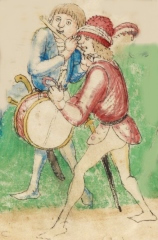
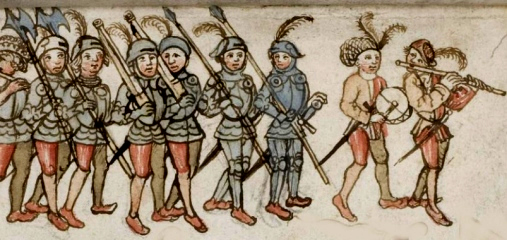
flute and drum duo |
At the same time as the pipe and tabor played by one person was in use, the duo of flute player and drummer
was in use in armies in Europe. In the 1400s the Swiss military used flute and drum as a means of communication
and to help their soldiers on long marches. Their presence on the battlefield and playing for court entertainments
can be documented from around 1470*. However " there are records in the Town Archives of Basel,
Switzerland, telling of the instruments's use as early as 1374".
"The Swiss soldiers created a two-man “field game” in connection with the new fighting style developed by their leaders:
the foot-harst, which rightly feared the enemy and charged forward in a closed fashion. In order to form this into an
orderly battle group,...the instruments used up to now, such as the horn, bagpipes, shawm or the thin flute of the minstrel
with the ...single-beat drum, were no longer sufficient. A larger, more sonorous drum, which could be struck powerfully
with two pieces of wood, was therefore needed.... It is said that the Swiss army marching in lockstep to the dull sound
of drums and the piercing tone of pipes emanated an archaic, primal force that filled the enemy with terror." [page 127]
The Germans adopted this military music.
* Benedikt Tschachtlan’s chronicle 1470
|
Disappearance of pipe and tabor for military use.
One-handed pipes and single-handed drums had two disadvantages, which caused them to disappear
from the troops in the 15th/16th century due to the new way of fighting on foot: Firstly, the range of melodies
of the pipe was limited, and more finger holes and the transition to the transverse flute required both hands
of the player. Secondly, the volume of the small minstrel drum was no longer sufficient for commanding
and signalling in the military, so it had to be larger and played by both hands.
‘GESCHICHTE DER SCHLAGINSTRUMENTE’ by Rudolf Baumann 2024 |
1487 fifers and drummers had been an integral
part of the military music of the Landsknecht
tradition. These
instruments were then
disseminated in the following decades by the Habsburg court to other European ruling
houses. They reached
Spain
in 1498.
'Trumpets, Gold, Minstrels and Death Music and the Armada of Pedro Arias Dávila in Castilla de Oro (Eastern Panama-Northwest Colombia)
1513-31' by Egberto Bermúdez, page 20 |
1489 Fife and Drum
“4 June 1489 at the banquet for the baptism of Antoine, the eldest of the sons of René II of Lorraine,
music was performed by "tambours, fifres et trompettes". |
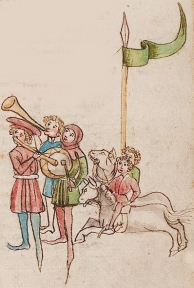 1450-1475 Germany [p. 36r ] 1450-1475 Germany [p. 36r ] |
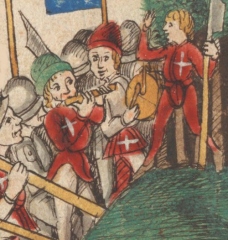 1470 Bern leading foot soldiers [p. 442] 1470 Bern leading foot soldiers [p. 442] |
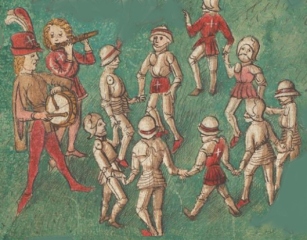 1470 Bern, playing for dancing [p. 248] 1470 Bern, playing for dancing [p. 248] |
|
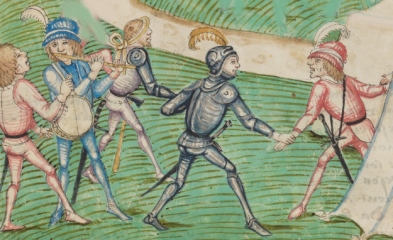 |
1478-1483 duo, Bern, Switzerland
[p. 96]
leading the soldiers into battle and playing for dancing soldiers [p.159] |
|
|
1492 “entry in the Privy Purse expenses
of Henry VII:
"2 Sweches grete taborers"
the sum of £2.
- foreign labour imported by either
royalty or nobility” |
English court accounts record the presence of the Swiss pair at Henry VIII’s court (1509-45).
The English chronicler
Holinshed records a masked ball given by Henry VIII in 1510:
" ‘there came in a drumme and a fife appareiled in white damaske…followed with torches".
‘Music and Poetry in the Tudor Court’, John Stevens, p. 247 |
The flutes and drums were retained in the Swiss, French and German armies well into the seventeenth century.
‘From Swiss Flutes to Consorts: History, Music and Playing Techniques of the Transverse Flute in Switzerland, Germany and France ca. 1470-1640’
by Nancy Hadden |
|
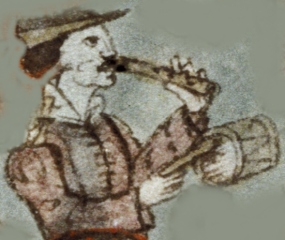 15th century 'Boke of Astronomy and off Philosophye'
  15th century stained glass window