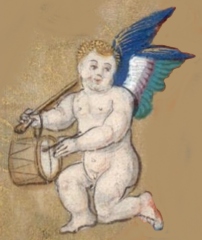
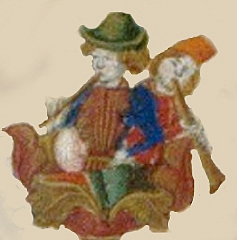
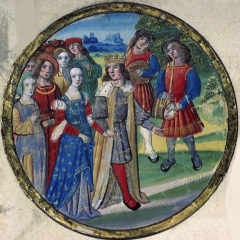
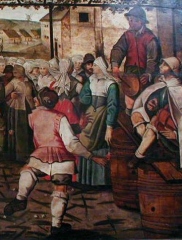
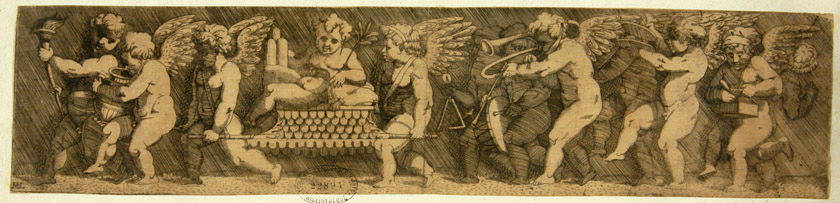
| Players/instruments were known as tambourin, taborin player, taberet. |
|
| |
|
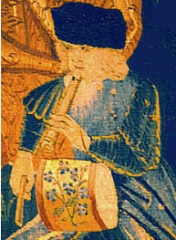 1500-1510 tapestry 1500-1510 tapestry |
|
 1503 manuscript, Paris 1503 manuscript, Paris |
|
|
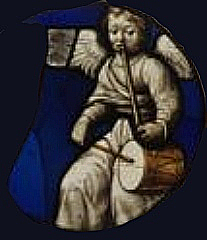
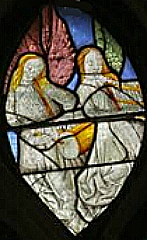 1500-1510 stained glass angel window,
Bourg-Achard, Normandy 1500-1510 stained glass angel window,
Bourg-Achard, Normandy |
|
|
 1514 book illustration 1514 book illustration |
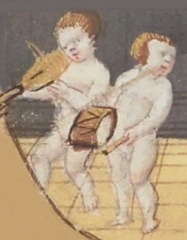 1515 manuscript, entertainerts 1515 manuscript, entertainerts
marginal illustration
|
 1517 entertaining at a meal 1517 entertaining at a meal |
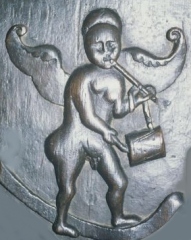
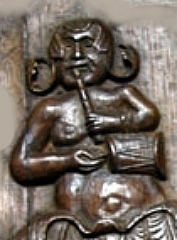 1520 wood carving 1520 wood carving
'La Guerchede' Brittany |
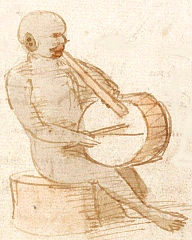 1520 illustrating a Christmas carol 1520 illustrating a Christmas carol |
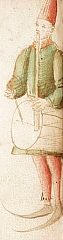 1525 illustrating a Christmas carol 1525 illustrating a Christmas carol |
 1525-1550 Bible 1525-1550 Bible
Valenciennes,
Upper France |
|
|
1517 Lyons (Auvergne-Rhône-Alpes): a legal case appearing before the court of the seneschal suggests that
pipe and tabor players formed a distinct class among minstrels, as
"Molhet and certain others among their associates, they who called themselves sworn masters of the art of the tabor players
and minstrels of the city... wanted to force the new tabor players and instrument makers to become masters, to create
masterpieces and to pay for certain banquets and money..."
Molhet, taborin player, is listed in accounts from 1507 onwards. he was buried in Saint Paul in 1524.
‘The musical sounds of medieval French cities : players, patrons, and politics’ by Peters, Gretchen, 2012 |
1530 backdrops for a performance of the ‘Mystére de la vengeance de Jhesus-Christ’ at Rheims (Grand Est )
include one scene
with a slightly raised stage for musicians. They are playing rebec, slide trumpet, pipe and tabor
and one other
unspecified wind instrument, to accompany a round dance going on in the middle of the canvas.
'MUSIC IN THE FRENCH SECULAR THEATER 1400-1550', by Howard Mayer Brown. 1963 |
1537 Paris
"
James Basset was studying in Paris and was taught to dance by a taberet:
Item, paid to Monsieur Simon, a tabourin , who taught him to dance for the second time
for the space of ij months. iij t s v j
‘Musical Instruments at the Court of Henry VIII’ by Palmer, Frances Lisle Letters IV, p 517 |
1548 Lyons; entry of Henry I and Queen Catherine de Medici. The city went to great lengths and acquired considerable
debt to impress the royal party with its loyalty and support…. Among the instrumentalists were pipe and tabor players,
some of whom were from Montbrison (Loire)
‘The musical sounds of medieval French cities : players, patrons, and politics’ by Peters, Gretchen, 2012 |
 beginning of the century, manuscript, north France
 1516-1530 playing with a harpist
 1560 painting
 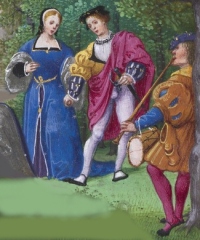 16th century
 after 1595